Advertisements
Advertisements
प्रश्न
A body is moving in a straight line and its displacement at various instants of time is given in the following table
| Time (s) | 0 | 1 | 2 | 3 | 4 | 5 | 6 | 7 |
| Displacement (m) | 2 | 6 | 12 | 12 | 12 | 18 | 22 | 24 |
Plot the displacement-time graph and calculate
(i) Total distance travelled in the interval 1 s to 5 s.
(ii) Average velocity in time interval 1 s to 5 s.
Advertisements
उत्तर
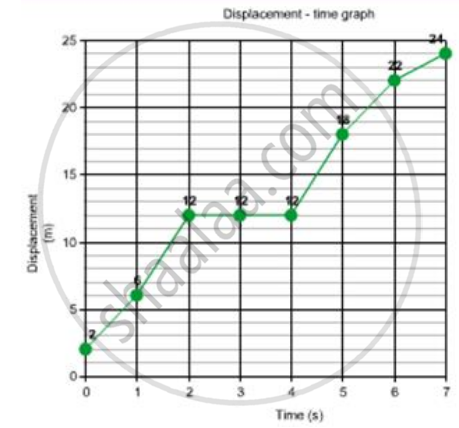
(i) Total distance travelled in interval 1s to 5s = 18m - 6m = 12 m.
(ii) Average velocity = Total displacement in the given time interval/Time interval, i.e. 1 s to 5 s.
Or, Average velocity = 12 m/4 s = 3 m/s.
APPEARS IN
संबंधित प्रश्न
A body is moving along a circular path of radius R. What will be the distance travelled and displacement of the body when it completes half a revolution ?
Is displacement a scalar quantity?
Draw a velocity-time graph for a body moving with an initial velocity u and uniform acceleration a. Use this graph to find the distance travelled by the body in time t.
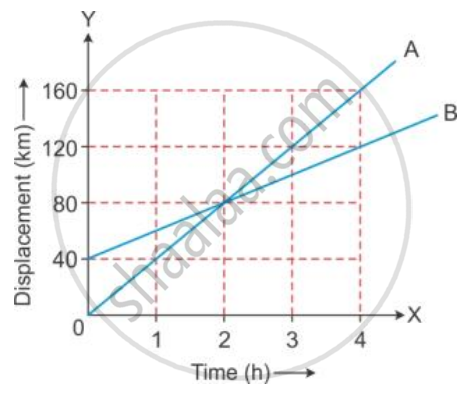
Figure ahead represents the displacement - time sketch of motion of two cars A and B . Find :
(i) the distance by which the car B was initially ahead of car A.
(ii) the velocities of car A and car B.
(iii) the time in which car A catches car B.
(iv) the distance from start when the car A will catch the car B.
A car travels a distance 100 m with constant acceleration and average velocity of 20 ms-1. The final velocity acquired by the car is 25 ms-1.
Find
(i) The initial velocity.
(ii) Acceleration of the car.
Calculate the distance and displacement in the following case: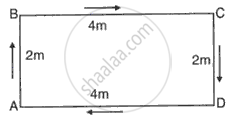
An object covers a distance of S meters in t seconds as follows :
| S (meters) | 0 | 8 | 20 | 20 | 16 | 10 | 0 |
| t (Seconds) | 80 | 2 | 5 | 10 | 12 | 15 | 10 |
Plot a graph, taking t on X-axis and S on Y-axis. Determine the velocity of the object at time
(i) 6 s, and
(ii) 14 s.
Match the following.
| 1. | Displacement | Knot |
| 2. | Light travelling through vacuum | Geometric centre |
| 3. | Speed of ship | Metre |
| 4. | Centre of gravity of geometrical shaped objects | Larger base area |
| 5. | Stability | Uniform velocity |
The displacement covered by the second hand of radius V in a clock after one revolution is ______.
If the displacement-time graph of a particle is parallel to the time axis, the velocity of the particle is ______.
