Advertisements
Advertisements
प्रश्न
Can displacement be zero even if the distance is not zero? Give one example to explain your answer.
Advertisements
उत्तर
Yes, displacement can be zero even if the distance is not zero.
For example, when a body is thrown vertically upwards from a point A on the ground, after sometime it comes back to the same point A. Then, the displacement is zero, but the distance travelled by the body is not zero (it is 2h; h is the maximum height attained by the body).
APPEARS IN
संबंधित प्रश्न
A body travels a distance of 3 km towards East, then 4 km towards North and finally 9 km towards East.
What is the total distance travelled ?
A body is moving in a straight line and its displacement at various instants of time is given in the following table
| Time (s) | 0 | 1 | 2 | 3 | 4 | 5 | 6 | 7 |
| Displacement (m) | 2 | 6 | 12 | 12 | 12 | 18 | 22 | 24 |
Plot the displacement-time graph and calculate
(i) Total distance travelled in the interval 1 s to 5 s.
(ii) Average velocity in time interval 1 s to 5 s.
A ball moves on a smooth floor in a straight line with uniform velocity 10 m s-1 for 6 s. At t = 6 s, the ball hits a wall and comes back along the same line to the starting point with the same speed. Draw the velocity-time graph and use it to find the total distance travelled by the ball and its displacement.
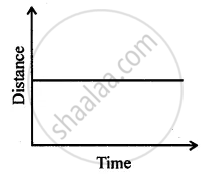
Can you suggest the kind of motion of a body from the following distance – time graph?
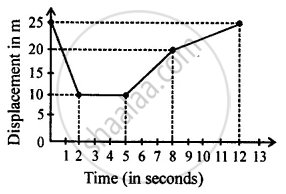
From the displacement – time graph shown given below calculate :
- Velocity between 0 – 2 s.
- Velocity between 8 s – 12 s.
- Average velocity between 5 s – 12 s.
The figure represents graphically the velocity of a car moving along a straight road over a period of 100 hours.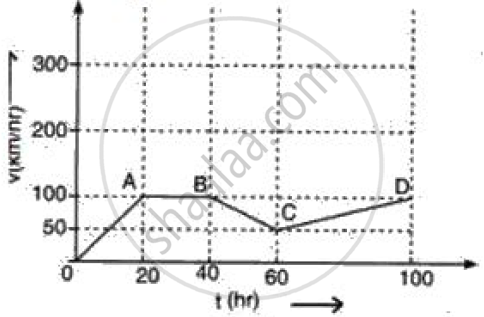
Calculate the distance travelled in the last 40 h.
An object covers a distance of S meters in t seconds as follows :
| S (meters) | 0 | 8 | 20 | 20 | 16 | 10 | 0 |
| t (Seconds) | 80 | 2 | 5 | 10 | 12 | 15 | 10 |
Plot a graph, taking t on X-axis and S on Y-axis. Determine the velocity of the object at time
(i) 6 s, and
(ii) 14 s.
State whether true or false. If false, correct the statement.
Distance covered by a particle never becomes zero but displacement becomes zero.
The displacement of a moving object in a given interval of time is zero. Would the distance travelled by the object also be zero? Justify your answer.
Displacement can be zero but distance never.
