Advertisements
Advertisements
प्रश्न
Can displacement be zero even if the distance is not zero? Give one example to explain your answer.
Advertisements
उत्तर
Yes, displacement can be zero even if the distance is not zero.
For example, when a body is thrown vertically upwards from a point A on the ground, after sometime it comes back to the same point A. Then, the displacement is zero, but the distance travelled by the body is not zero (it is 2h; h is the maximum height attained by the body).
APPEARS IN
संबंधित प्रश्न
What is the difference between distance travelled by a body and its displacement ? Explain with the
help of a diagram.
Is displacement a scalar quantity?
What can you say about the nature of motion of a body if its displacement-time graph is A curve.
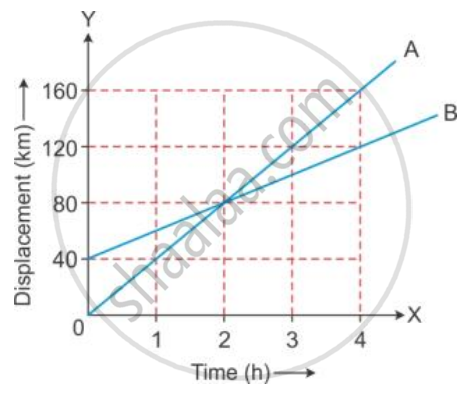
Figure ahead represents the displacement - time sketch of motion of two cars A and B . Find :
(i) the distance by which the car B was initially ahead of car A.
(ii) the velocities of car A and car B.
(iii) the time in which car A catches car B.
(iv) the distance from start when the car A will catch the car B.
Define Distance.
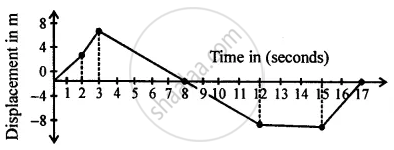
From the displacement – time graph shown given below calculate:
- Average velocity in the first three seconds.
- Displacement from the initial position at the end of 13 s.
- Time after which the body is at the initial position,
- Average velocity after 8 s.
Ashok starts from his house and travels 3 km to reach his school. On finding the school gates closed, he returns to his house. What is?
The displacement of Ashok
An object is thrown vertically upwards. It rises upto a height H and then returns to its initial position. Calculate
The displacement of the object.
Geetha takes 15 minutes from her house to reach her school on a bicycle. If the bicycle has a speed of 2 m/s, calculate the distance between her house and the school.
Displacement is the ______ distance covered by a body.
