Advertisements
Advertisements
प्रश्न
The table below shows the distance travelled by two vehicles A and B during each second:
| Time (s) | 0 | 1 | 2 | 3 | 4 | 5 | 6 | 7 |
| Distance travelled by A (m) | 0 | 20 | 80 | 180 | 240 | 300 | 360 | 420 |
| Distance travelled by B (m) | 0 | 10 | 40 | 90 | 160 | 250 | 360 | 490 |
Give the value of the velocity at which they are meeting
Advertisements
उत्तर
Velocity of both the vehicles is 60 m/s when they meet.
APPEARS IN
संबंधित प्रश्न
A body travels a distance of 3 km towards East, then 4 km towards North and finally 9 km towards East.
What is the total distance travelled ?
A particle is moving in a circular path of radius r. The displacement after half a circle would be :
A body starts with an initial velocity of 10m s-1 and acceleration 5 m s-2. Find the distance covered by it in 5 s.
A body is moving along a circular path of radius r. What will be the distance and displacement of the body when it completes:
Two full revolutions
An object is thrown vertically upwards. It rises upto a height H and then returns to its initial position. Calculate
The total distance traveled by the object
The figure represents graphically the velocity of a car moving along a straight road over a period of 100 hours.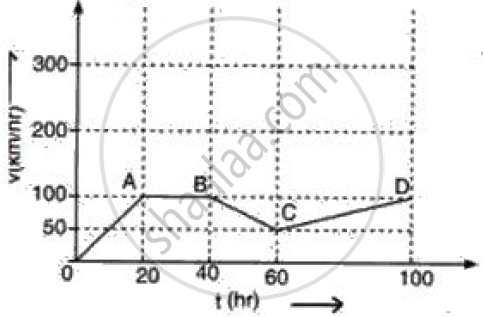
Calculate the distance travelled in the last 40 h.
The table below shows the distance travelled by two vehicles A and B during each second:
| Time (s) | 0 | 1 | 2 | 3 | 4 | 5 | 6 | 7 |
| Distance travelled by A (m) | 0 | 20 | 80 | 180 | 240 | 300 | 360 | 420 |
| Distance travelled by B (m) | 0 | 10 | 40 | 90 | 160 | 250 | 360 | 490 |
Which vehicle is moving with uniform velocity?
Distance travelled by a body in a given time ______.
An object is dropped from rest at a height of 150 m and simultaneously another object is dropped from rest at a height of 100 m. What is the difference in their heights after 2s if both the objects drop with the same accelerations? How does the difference in heights vary with time?
Distance travelled by a freely falling body is proportional to ______.
