Advertisements
Advertisements
प्रश्न
A body is moving along a circular path of radius r. What will be the distance and displacement of the body when it completes:
Two full revolutions
Advertisements
उत्तर
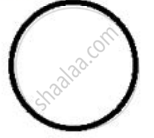
Distance travelled is two times the perimeter of cirle.
So distance travelled is =4π r.
Displacement =0 as starting and ending point are coinciding.
APPEARS IN
संबंधित प्रश्न
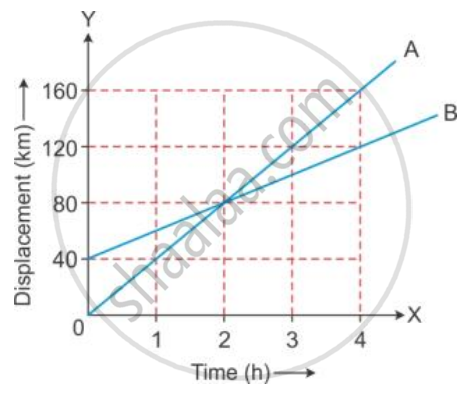
Figure ahead represents the displacement - time sketch of motion of two cars A and B . Find :
(i) the distance by which the car B was initially ahead of car A.
(ii) the velocities of car A and car B.
(iii) the time in which car A catches car B.
(iv) the distance from start when the car A will catch the car B.
A body starts from rest with uniform acceleration 2 m s-2. Find the distance covered by the body in 2 s.
Give two differences between displacement and distance.
How can you find the following?
Velocity from a displacement – time graph.
Calculate the distance and displacement in the following case: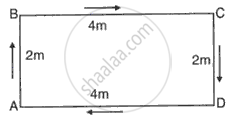
A satellite makes a complete round along its circular orbit. What is its displacement?
An object is thrown vertically upwards. It rises upto a height H and then returns to its initial position. Calculate
The displacement of the object.
The table below shows the distance travelled by two vehicles A and B during each second:
| Time (s) | 0 | 1 | 2 | 3 | 4 | 5 | 6 | 7 |
| Distance travelled by A (m) | 0 | 20 | 80 | 180 | 240 | 300 | 360 | 420 |
| Distance travelled by B (m) | 0 | 10 | 40 | 90 | 160 | 250 | 360 | 490 |
Which vehicle is moving with uniform velocity?
Displacement / Time : Velocity :: Speed / Time : ______.
Write a note on the following:
Nautical mile
