Advertisements
Advertisements
प्रश्न
An object is thrown vertically upwards. It rises upto a height H and then returns to its initial position. Calculate
The displacement of the object.
Advertisements
उत्तर
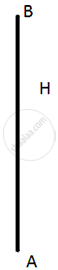
Total displacement =0 as starting and ending points are coinciding.
APPEARS IN
संबंधित प्रश्न
What information about the motion of a body are obtained from the displacement-time graph?
Define displacement.
Show the difference between distance and displacement with the help of a diagram.
Under what condition is the displacement of a body equal to the distance traveled by it?
A body is moving along a circular path of radius r. What will be the distance and displacement of the body when it completes:
Half a revolution
Displacement / Time : Velocity :: Speed / Time : ______.
Give one example where the displacement is zero but the distance travelled is not zero.
A scalar quantity has ______.
The displacement covered by the second hand of radius V in a clock after one revolution is ______.
Displacement magnitude can be greater than the distance traveled by the object.
