Advertisements
Advertisements
प्रश्न
What can you say about the nature of motion of a body if its displacement-time graph is A curve.
Advertisements
उत्तर
It depicts that the body is moving with variable velocity.
APPEARS IN
संबंधित प्रश्न
From the displacement-time graph of a cyclist given below in the Figure, find The displacement from the initial position at the end of 10 s,
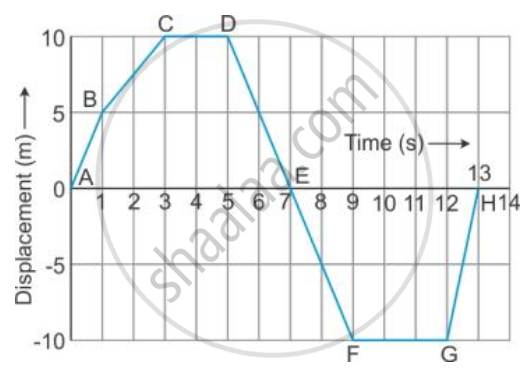
Figure (a) shows the velocity-time graph for the motion of a body. Use it to find the displacement of the body at t = 1 s, 2 s, 3 s and 4 s, then draw on Figure (b), the displacement-time graph for it.
 |
 |
| (a) | (b) |
Figure shows the velocity-time graph of a particle moving in a straight line.
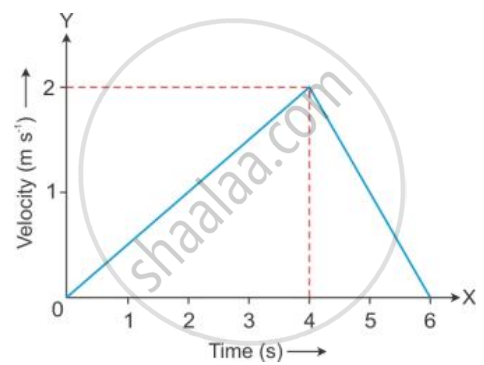
(i) State the nature of motion of particle.
(ii) Find the displacement of particle at t = 6 s.
(iii) Does the particle change its direction of motion?
(iv) Compare the distance travelled by the particle from 0 to 4 s and from 4 s to 6 s.
(v) Find the acceleration from 0 to 4 s and retardation from 4 s to 6 s.
Define Displacement.
Draw displacement – time graph for the following situation:
When a body is moving with variable velocity.
Define displacement.
Ashok starts from his house and travels 3 km to reach his school. On finding the school gates closed, he returns to his house. What is?
The distance traveled by Ashok.
A particle is moving in a circular pattern of radius r. The displacement after half a circle would be ______.
The rate of change of displacement ______.
Assertion: If the displacement of the body is zero, the distance covered by it may not be zero.
Reason: Displacement is a vector & distance is a scalar quantity.
