Advertisements
Advertisements
प्रश्न
A ball moves on a smooth floor in a straight line with uniform velocity 10 m s-1 for 6 s. At t = 6 s, the ball hits a wall and comes back along the same line to the starting point with the same speed. Draw the velocity-time graph and use it to find the total distance travelled by the ball and its displacement.
Advertisements
उत्तर
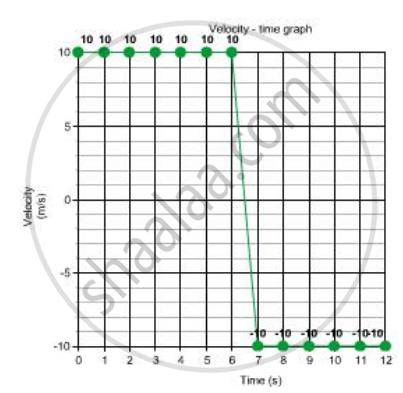
Distance travelled in first 6 s = velocity × time
= 10 m/s × 6
= 60 m
Distance travelled in next 6 s = velocity × time
= 10 m/s × 6
= 60 m
Total distance travelled in 12 s = (60 + 60) m = 120 m
Total displacement = 0, as the ball returns its starting point.
APPEARS IN
संबंधित प्रश्न
If on a round trip you travel 6 km and then arrive back home :
What is your final displacement ?
Is displacement a scalar quantity?
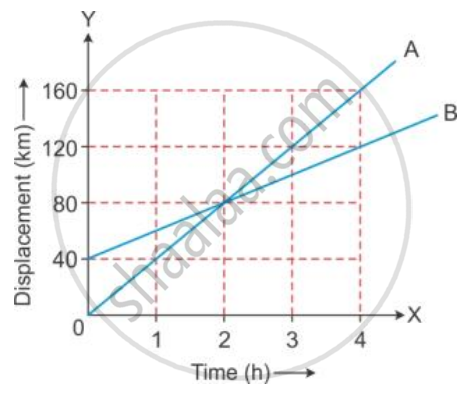
Figure ahead represents the displacement - time sketch of motion of two cars A and B . Find :
(i) the distance by which the car B was initially ahead of car A.
(ii) the velocities of car A and car B.
(iii) the time in which car A catches car B.
(iv) the distance from start when the car A will catch the car B.
How can you find the following?
Velocity from a displacement – time graph.
Write the SI units for measurement of distance and displacement.
A body is moving along a circular path of radius r. What will be the distance and displacement of the body when it completes:
Full revolution
A body is moving along a circular path of radius r. What will be the distance and displacement of the body when it completes:
Two full revolutions
A satellite makes a complete round along its circular orbit. What is its displacement?
A car starts from rest and moves along the x-axis with constant acceleration 5 ms–2 for 8 seconds. If it then continues with constant velocity, what distance will the car cover in 12 seconds since it started from the rest?
Displacement is the ______ distance covered by a body.
