Advertisements
Advertisements
प्रश्न
Figure shows the velocity-time graph of a particle moving in a straight line.
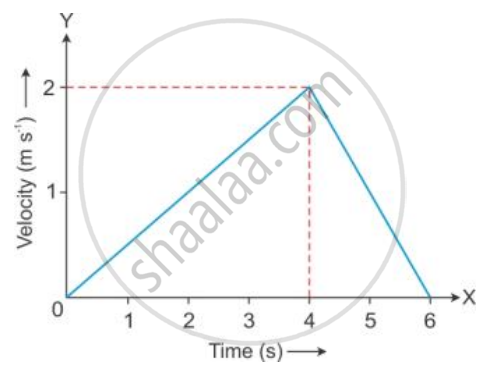
(i) State the nature of motion of particle.
(ii) Find the displacement of particle at t = 6 s.
(iii) Does the particle change its direction of motion?
(iv) Compare the distance travelled by the particle from 0 to 4 s and from 4 s to 6 s.
(v) Find the acceleration from 0 to 4 s and retardation from 4 s to 6 s.
Advertisements
उत्तर
(i) From 0 to 4 seconds, the motion is uniformly accelerated and from 4 to 6 seconds, the motion is uniformly retarded.
(ii) Displacement of the particle at 6 s = (1/2) (6) (2) = 6 m
(iii) The particle does not change its direction of motion.
(iv) Distance travelled by the particle from 0 to 4s (D1) = (1/2) (4) (2) = 4 m
Distance travelled by the particle from 4 to 6s (D2) = (1/2) (2) (2) = 2 m
D1:D2:: 4:2
D1:D2:: 2:1
(v) Acceleration from 0 to 4 s = (2/4) ms-2 or 0.5 ms-2
Retardation from 4 s to 6 s = (2/2) ms-2 or 1 ms-2.
APPEARS IN
संबंधित प्रश्न
An athlete completes one round of a circular track of diameter 200 m in 40 s. What will be the distance covered and the displacement at the end of 2 minutes 20 s?
If on a round trip you travel 6 km and then arrive back home :
What is your final displacement ?
The numerical ratio of displacement to distance for a moving object is :
Figure ahead represents the displacement - time sketch of motion of two cars A and B . Find :
(i) the distance by which the car B was initially ahead of car A.
(ii) the velocities of car A and car B.
(iii) the time in which car A catches car B.
(iv) the distance from start when the car A will catch the car B.
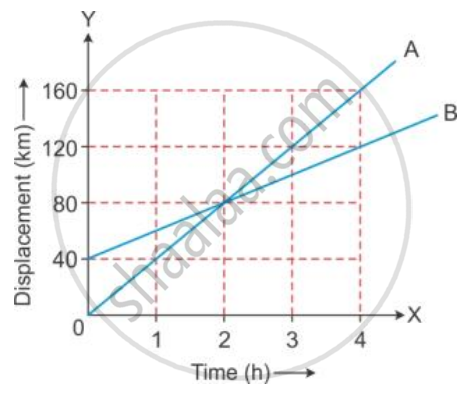
Figure given below shows a velocity-time graph for a car starting from rest. The graph has three parts AB, BC and CD.
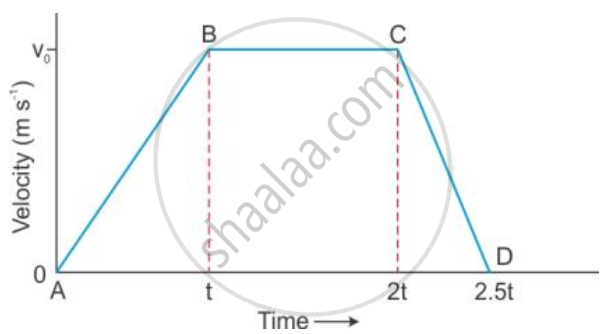
Compare the distance travelled in part BC with the distance travelled in part AB.
Define Distance.
Name the physical quantity associated with the rate of change of displacement with time.
Exercise Problems.
An athlete completes one round of a circular track of diameter 200 m in 40 s. What will be the distance covered and the displacement at the end of 2 m and 20 s?
The displacement covered by the second hand of radius V in a clock after one revolution is ______.
Choose the correct option.
