Advertisements
Advertisements
प्रश्न
Exercise Problems.
An athlete completes one round of a circular track of diameter 200 m in 40 s. What will be the distance covered and the displacement at the end of 2 m and 20 s?
Advertisements
उत्तर
Given: Diameter of circular track = 200m
time to complete = 40s
Formula: Circumference of circular track = d. π m
speed = `"distance"/"time"`
Solution:
Circumference of the track = d.π
= 200 × 3.14 = 628m
speed = `"628m"/"40s"` = 15.7 ms– 1
Distance covered in 2 min 20 s = speed × time
In the given time athlete covers 31/2 rounds = 2198m

The final position of athlete is as shown in figure (A – initial position, B – final position)
∴ Displacement = Distance × time
= 200 m
APPEARS IN
संबंधित प्रश्न
The displacement of a moving object in a given interval of time is zero. Would the distance travelled by the object also be zero ? Give reason for your answer.
What is the difference between distance travelled by a body and its displacement ? Explain with the
help of a diagram.
A body is moving in a straight line and its displacement at various instants of time is given in the following table
| Time (s) | 0 | 1 | 2 | 3 | 4 | 5 | 6 | 7 |
| Displacement (m) | 2 | 6 | 12 | 12 | 12 | 18 | 22 | 24 |
Plot the displacement-time graph and calculate
(i) Total distance travelled in the interval 1 s to 5 s.
(ii) Average velocity in time interval 1 s to 5 s.
Figure given below shows a velocity-time graph for a car starting from rest. The graph has three parts AB, BC and CD.
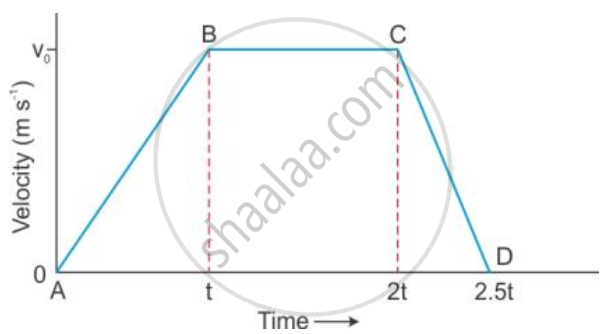
Compare the distance travelled in part BC with the distance travelled in part AB.
Figure given below shows a velocity-time graph for a car starting from rest. The graph has three parts AB, BC and CD.
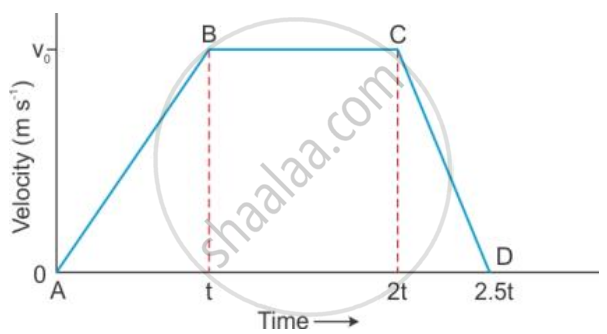
State how is the distance travelled in any part determined from this graph .
How can you find the following?
Velocity from a displacement – time graph.
Can you suggest the kind of motion of a body from the following distance – time graph?
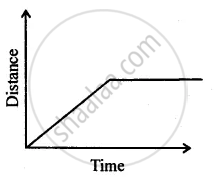
Write the SI units for measurement of distance and displacement.
A body is moving along a circular path of radius r. What will be the distance and displacement of the body when it completes:
Half a revolution
A quantity that has both magnitude and direction is ______.
