Advertisements
Advertisements
Question
Exercise Problems.
An athlete completes one round of a circular track of diameter 200 m in 40 s. What will be the distance covered and the displacement at the end of 2 m and 20 s?
Advertisements
Solution
Given: Diameter of circular track = 200m
time to complete = 40s
Formula: Circumference of circular track = d. π m
speed = `"distance"/"time"`
Solution:
Circumference of the track = d.π
= 200 × 3.14 = 628m
speed = `"628m"/"40s"` = 15.7 ms– 1
Distance covered in 2 min 20 s = speed × time
In the given time athlete covers 31/2 rounds = 2198m

The final position of athlete is as shown in figure (A – initial position, B – final position)
∴ Displacement = Distance × time
= 200 m
APPEARS IN
RELATED QUESTIONS
A boy walks from his classroom to the bookshop along a straight corridor towards North. He covers a distance of 20 m in 25 seconds to reach the bookshop. After buying a book, he travels the same distance in the same time to reach back in the classroom. Find (a) average speed, and (b) average velocity, of the boy.
A body is moving in a straight line and its displacement at various instants of time is given in the following table
| Time (s) | 0 | 1 | 2 | 3 | 4 | 5 | 6 | 7 |
| Displacement (m) | 2 | 6 | 12 | 12 | 12 | 18 | 22 | 24 |
Plot the displacement-time graph and calculate
(i) Total distance travelled in the interval 1 s to 5 s.
(ii) Average velocity in time interval 1 s to 5 s.
Draw displacement – time graph for the following situation:
When a body is moving with variable velocity.
Ashok starts from his house and travels 3 km to reach his school. On finding the school gates closed, he returns to his house. What is?
The distance traveled by Ashok.
The graph shows how the velocity of a scooter varies with time in 50 s.
Work out: The distance traveled in 10 s, 20 s, and 50 s.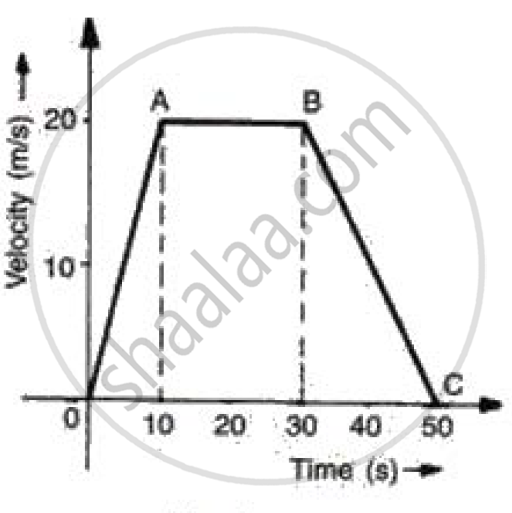
Which of the following figures represent uniform motion of a moving object correctly?
Displacement / Time : Velocity :: Speed / Time : ______.
Write a note on the following:
Nautical mile
A body is projected up with an initial velocity of u m/s. It goes up to a height, ‘h’ meters in seconds' time. Then it comes back at the point of projection.
Considering negligible air resistance, which of the following statement is true?
A man leaves his house at 6.30 a.m. for a morning walk and returns back at 7.30 a.m. after covering 4 km. The Displacement covered by him is ______.
