Advertisements
Advertisements
Question
Draw displacement – time graph for the following situation:
When a body is moving with variable velocity.
Advertisements
Solution
Displacement – time graph When a body is moving with variable velocity.

APPEARS IN
RELATED QUESTIONS
Define displacement. State its unit.
Differentiate between distance and displacement.
Draw a velocity-time graph for a body moving with an initial velocity u and uniform acceleration a. Use this graph to find the distance travelled by the body in time t.
A body is moving in a straight line and its displacement at various instants of time is given in the following table
| Time (s) | 0 | 1 | 2 | 3 | 4 | 5 | 6 | 7 |
| Displacement (m) | 2 | 6 | 12 | 12 | 12 | 18 | 22 | 24 |
Plot the displacement-time graph and calculate
(i) Total distance travelled in the interval 1 s to 5 s.
(ii) Average velocity in time interval 1 s to 5 s.
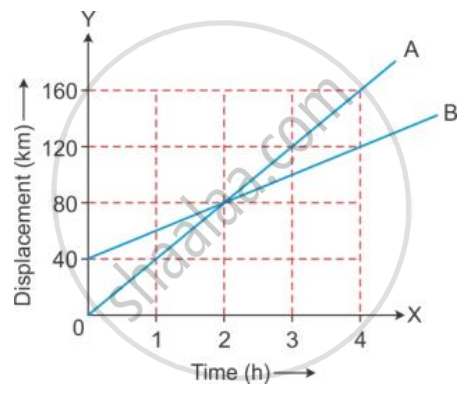
Figure ahead represents the displacement - time sketch of motion of two cars A and B . Find :
(i) the distance by which the car B was initially ahead of car A.
(ii) the velocities of car A and car B.
(iii) the time in which car A catches car B.
(iv) the distance from start when the car A will catch the car B.
Match the following.
| 1. | Displacement | Knot |
| 2. | Light travelling through vacuum | Geometric centre |
| 3. | Speed of ship | Metre |
| 4. | Centre of gravity of geometrical shaped objects | Larger base area |
| 5. | Stability | Uniform velocity |
Distance travelled by a body in a given time ______.
A body is projected up with an initial velocity of u m/s. It goes up to a height, ‘h’ meters in seconds' time. Then it comes back at the point of projection.
Considering negligible air resistance, which of the following statement is true?
Choose the correct option.
Distance travelled by a freely falling body is proportional to ______.
