Advertisements
Advertisements
Question
A body is moving along a circular path of radius r. What will be the distance and displacement of the body when it completes:
`(3/4)` th of a revolution
Advertisements
Solution
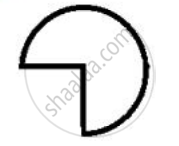
Distance travelled = (3/ 4) of perimeter of circle.
So distance travelled is = (3π r/ 2).
Displacement can be calculated ass = √r2+r2 = √2r.
APPEARS IN
RELATED QUESTIONS
Clarify the difference.
Distance and displacement
Write an expression for the distance S covered in time t by a body which is initially at rest and starts moving with a constant acceleration a.
A car covers 90 km in `1 1/2` hours towards east. Calculate
- displacement of car,
- its velocity in (a) kmh−1 (b) ms−1.
A racehorse runs straight towards the north and covers 540 m in one minute. Calculate
- displacement of the horse,
- its velocity in (a) ms−1 (b) kmh−1.
Draw displacement – time graph for the following situation:
When a body is moving with uniform velocity.
Show the difference between distance and displacement with the help of a diagram.
Which of the following figures represent uniform motion of a moving object correctly?
Give some examples for vector quantity.
Write a note on the following:
knot
Slope of a velocity-time graph gives
