Advertisements
Advertisements
Question
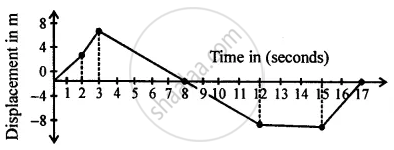
From the displacement – time graph shown given below calculate:
- Average velocity in the first three seconds.
- Displacement from the initial position at the end of 13 s.
- Time after which the body is at the initial position,
- Average velocity after 8 s.
Advertisements
Solution
(i) In first three seconds
Total displacement = 8m
Total time = 3 s
Average velocity = Total displacement/Total time = 8/3
= 2.67 ms−1
(ii) Displacement from the initial position at the end of 13s = −8m.
(iii) Body is at the initial position after 8s and 17s.
(iv) Average velocity after 8s is zero because, after 8s, displacement is zero.
APPEARS IN
RELATED QUESTIONS
Is displacement a scalar quantity ?
The displacement of a moving object in a given interval of time is zero. Would the distance travelled by the object also be zero ? Give reason for your answer.
If on a round trip you travel 6 km and then arrive back home :
What is your final displacement ?
A boy walks from his classroom to the bookshop along a straight corridor towards North. He covers a distance of 20 m in 25 seconds to reach the bookshop. After buying a book, he travels the same distance in the same time to reach back in the classroom. Find (a) average speed, and (b) average velocity, of the boy.
State how the velocity-time graph can be used to find The displacement of the body in a given time.
What can you say about the nature of motion of a body if its displacement-time graph is A straight line parallel to the time axis?
Under what condition is the displacement of a body equal to the distance traveled by it?
An object is thrown vertically upwards. It rises upto a height H and then returns to its initial position. Calculate
The total distance traveled by the object
The SI unit of displacement is ______.
An ant moves from one corner of a room diagonally to the opposite corner. If the dimensions of the hall are 8m x 6m, the displacement of the ant is ______.
