Advertisements
Advertisements
Question
State whether true or false. If false, correct the statement.
Distance covered by a particle never becomes zero but displacement becomes zero.
Options
True
False
Advertisements
Solution
Distance covered by a particle never becomes zero but displacement becomes zero- True
APPEARS IN
RELATED QUESTIONS
The displacement of a moving object in a given interval of time is zero. Would the distance travelled by the object also be zero ? Give reason for your answer.
What is the difference between distance travelled by a body and its displacement ? Explain with the
help of a diagram.
In which of the following cases of motion, the distance moved and the magnitude of displacement are equal?
A body when projected up with an initial velocity u goes to a maximum height h in time t and then comes back at the point of projection. The correct statement is ______________
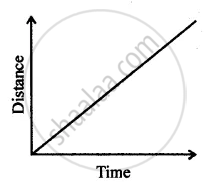
Can you suggest the kind of motion of a body from the following distance – time graph?
Define displacement.
A satellite makes a complete round along its circular orbit. What is its displacement?
An object is dropped from rest at a height of 150 m and simultaneously another object is dropped from rest at a height of 100 m. What is the difference in their heights after 2s if both the objects drop with the same accelerations? How does the difference in heights vary with time?
Displacement is the ______ distance covered by a body.
Displacement can be zero but distance never.
