Advertisements
Advertisements
Question
The displacement of a moving object in a given interval of time is zero. Would the distance travelled by the object also be zero ? Give reason for your answer.
Advertisements
Solution
Displacement is a vector quantity, so it can be zero for two reasons:
1. When the body doesn't move at all: In this case, the distance travelled will also be zero.
2. When the body comes back to its initial position: In this case, the distance travelled is non-zero, but the displacement is zero.
APPEARS IN
RELATED QUESTIONS
A particle is moving in a circular path of radius r. The displacement after half a circle would be :
A train takes 3 h to travel from Agra to Delhi with a uniform speed of 65 km h-1. Find the distance between the two cities.
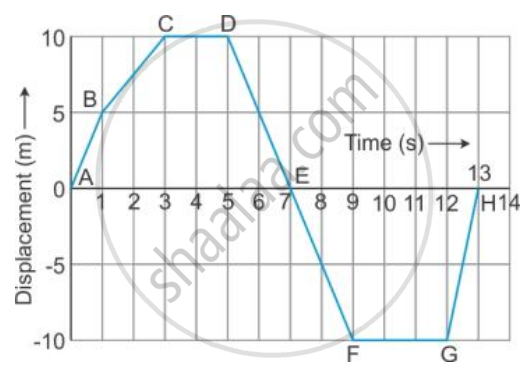
From the displacement-time graph of a cyclist given below in the Figure, find The displacement from the initial position at the end of 10 s,
Explain the following concept in your own words with everyday examples:
Distance
Give an example of a body which covers a certain distance, but its displacement is zero.
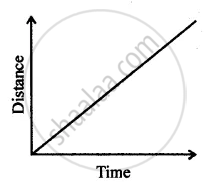
Can you suggest the kind of motion of a body from the following distance – time graph?
Is distance covered during nth second more than the distance covered in n seconds?
Match the following.
| 1. | Displacement | Knot |
| 2. | Light travelling through vacuum | Geometric centre |
| 3. | Speed of ship | Metre |
| 4. | Centre of gravity of geometrical shaped objects | Larger base area |
| 5. | Stability | Uniform velocity |
Slope of a velocity-time graph gives
In which of the following cases of motions, the distance moved and the magnitude of displacement are equal?
