Advertisements
Advertisements
Question
A particle is moving in a circular path of radius r. The displacement after half a circle would be
Options
Zero
R
2r
r/2
Advertisements
Solution
2r
APPEARS IN
RELATED QUESTIONS
Clarify the difference.
Distance and displacement
State how the velocity-time graph can be used to find The distance travelled by the body in a given time
What can you say about the nature of motion of a body if its displacement-time graph is A straight line parallel to the time axis?
What can you say about the nature of motion of a body if its displacement-time graph is A straight line inclined to the time axis with an obtuse angle?
A ball moves on a smooth floor in a straight line with uniform velocity 10 m s-1 for 6 s. At t = 6 s, the ball hits a wall and comes back along the same line to the starting point with the same speed. Draw the velocity-time graph and use it to find the total distance travelled by the ball and its displacement.
Figure shows the velocity-time graph of a particle moving in a straight line.
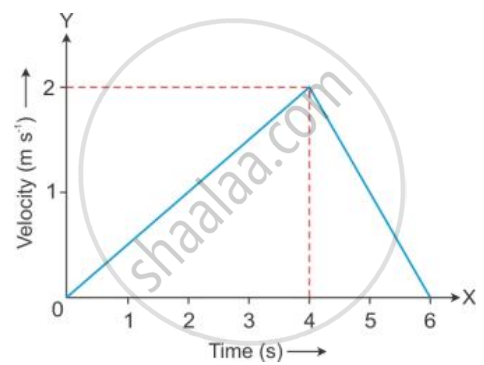
(i) State the nature of motion of particle.
(ii) Find the displacement of particle at t = 6 s.
(iii) Does the particle change its direction of motion?
(iv) Compare the distance travelled by the particle from 0 to 4 s and from 4 s to 6 s.
(v) Find the acceleration from 0 to 4 s and retardation from 4 s to 6 s.
Explain the following concept in your own words with everyday examples:
Distance
Calculate the distance and displacement in the following case: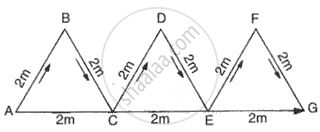
Using the following data, draw time - displacement graph for a moving object:
| Time (s) | 0 | 2 | 4 | 6 | 8 | 10 | 12 | 14 | 16 |
| Displacement (m) | 0 | 2 | 4 | 4 | 4 | 6 | 4 | 2 | 0 |
Use this graph to find average velocity for the first 4 s, for the next 4 s and for the last 6 s.
Distance travelled by a freely falling body is proportional to ______.
