Advertisements
Advertisements
Question
A ball moves on a smooth floor in a straight line with uniform velocity 10 m s-1 for 6 s. At t = 6 s, the ball hits a wall and comes back along the same line to the starting point with the same speed. Draw the velocity-time graph and use it to find the total distance travelled by the ball and its displacement.
Advertisements
Solution
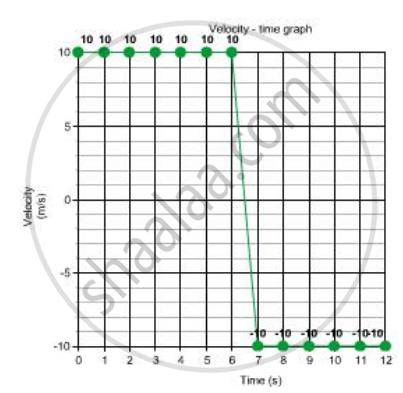
Distance travelled in first 6 s = velocity × time
= 10 m/s × 6
= 60 m
Distance travelled in next 6 s = velocity × time
= 10 m/s × 6
= 60 m
Total distance travelled in 12 s = (60 + 60) m = 120 m
Total displacement = 0, as the ball returns its starting point.
APPEARS IN
RELATED QUESTIONS
A particle is moving in a circular path of radius r. The displacement after half a circle would be :
In which of the following cases of motion, the distance moved and the magnitude of displacement are equal?
A train takes 3 h to travel from Agra to Delhi with a uniform speed of 65 km h-1. Find the distance between the two cities.
A car starting from rest accelerates uniformly to acquire a speed 20 km h-1 in 30 min. The distance travelled by a car in this time interval will be _____________
Give an example of a body which covers a certain distance, but its displacement is zero.
A motor car slows down from 72 kmh−1 to 36 kmh−1 over a distance of 25 m. If the brakes are applied with the same force
calculate
- total time in which car comes to rest
- distance travelled by it.
An object is thrown vertically upwards. It rises upto a height H and then returns to its initial position. Calculate
The total distance traveled by the object
An object is thrown vertically upwards. It rises upto a height H and then returns to its initial position. Calculate
The displacement of the object.
Write a note on the following:
knot
The displacement covered by the second hand of radius V in a clock after one revolution is ______.
