Advertisements
Advertisements
प्रश्न
A ball moves on a smooth floor in a straight line with uniform velocity 10 m s-1 for 6 s. At t = 6 s, the ball hits a wall and comes back along the same line to the starting point with the same speed. Draw the velocity-time graph and use it to find the total distance travelled by the ball and its displacement.
Advertisements
उत्तर
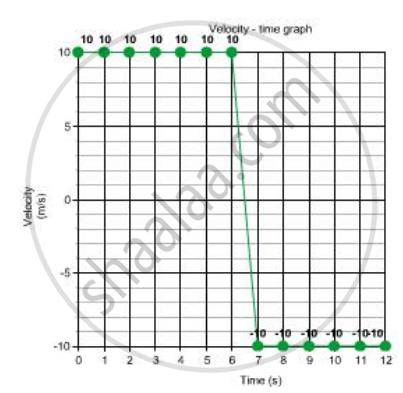
Distance travelled in first 6 s = velocity × time
= 10 m/s × 6
= 60 m
Distance travelled in next 6 s = velocity × time
= 10 m/s × 6
= 60 m
Total distance travelled in 12 s = (60 + 60) m = 120 m
Total displacement = 0, as the ball returns its starting point.
APPEARS IN
संबंधित प्रश्न
A farmer moves along the boundary of a square field of side 10 m in 40 s. What will be the magnitude of displacement of the farmer at the end of 2 minutes 20 seconds?
If on a round trip you travel 6 km and then arrive back home :
What distance have you travelled ?
Explain the following concept in your own words with everyday examples:
Distance
Calculate the distance and displacement in the following case: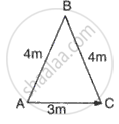
Name the physical quantity associated with the rate of change of displacement with time.
A 50 m long train passes over a bridge at a speed of 30 km/h. If it takes 36 seconds to cross the bridge, calculate the length of the bridge.
Which of the following is correct?
An object is dropped from rest at a height of 150 m and simultaneously another object is dropped from rest at a height of 100 m. What is the difference in their heights after 2s if both the objects drop with the same accelerations? How does the difference in heights vary with time?
The displacement covered by the second hand of radius V in a clock after one revolution is ______.
Displacement is the ______ distance covered by a body.
