Advertisements
Advertisements
प्रश्न
The velocity-time graph of a moving body is given below in Figure
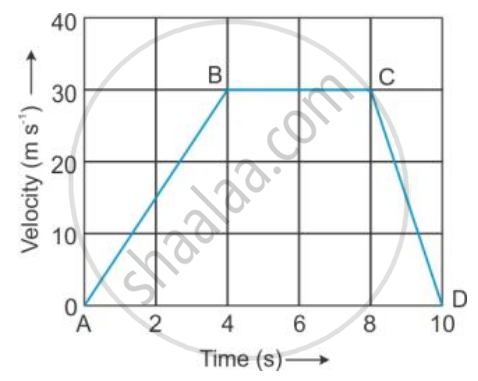
Total displacement.
Advertisements
उत्तर
Total displacement = Displacement of part AB + Displacement of part BC + Displacement of part CD
= 60 + 120 + 30 = 210 m
APPEARS IN
संबंधित प्रश्न
What does the odometer of an automobile measure?
Arrange the following speed in increasing order (keeping the least speed first
A scooter moving with a speed of 30 km/h.
A tortoise moves a distance of 100 metres in 15 minutes. What is the average speed of tortoise in km/h ?
A car is moving along a straight road at a steady speed. It travels 150 m in 5 seconds:
How long does it take to travel 240 m ?
The speed of a moving object is determined to be 0.06 m/s. This speed is equal to :
Express 15 m s-1 in km h-1.
A car moving on a straight path covers a distance of 1 km due east in 100 s. What is velocity of the car?
A car accelerates at a rate of 5 m s-2. Find the increase in its velocity in 2 s.
A car is moving in a straight line with speed 18 km h-1. It is stopped in 5 s by applying the brakes. Find:
- the speed of car in m s-1
- the retardation and
- the speed of car after 2 s of applying the brakes.
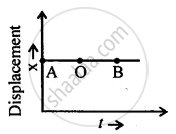
Write down the type of motion of a body along with the A – O – B of the following distance – time graph.