Advertisements
Advertisements
प्रश्न
The velocity-time graph of a moving body is given below in Figure
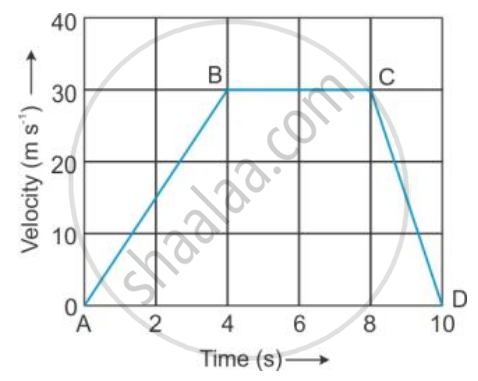
Total displacement.
Advertisements
उत्तर
Total displacement = Displacement of part AB + Displacement of part BC + Displacement of part CD
= 60 + 120 + 30 = 210 m
APPEARS IN
संबंधित प्रश्न
Name the physical quantity which gives us an idea of how slow or fast a body is moving.
What is the SI unit of retardation ?
A bus moving along a straight line at 20 m/s undergoes an acceleration of 4 m/s2. After 2 seconds, its speed will be:
Express 15 m s-1 in km h-1.
Figure shows the displacement of a body at different times .
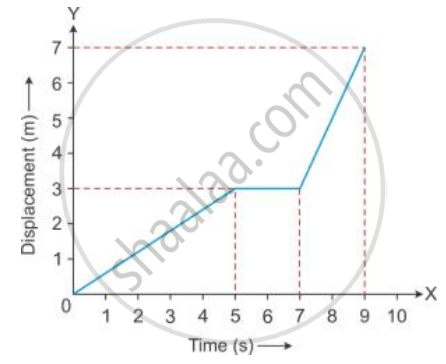
Calculate the average velocity during the time interval 5 s to 9 s ,
[Hint : From 5 s to 9 s , displacement = 7 m - 3m = 4m]
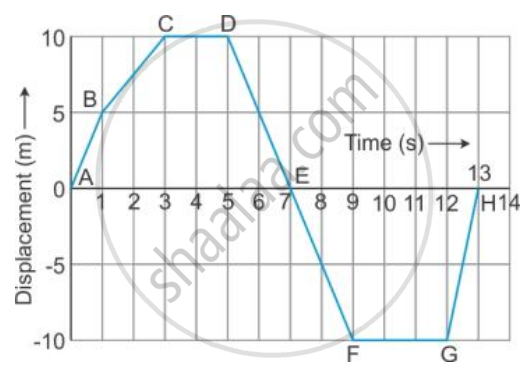
From the displacement-time graph of a cyclist given below in the Figure, find The average velocity in the first 4 s.
What is the relation between distance and time when the body is moving with uniform velocity?
Draw a diagram to show the motion of a body whose speed remains constant, but velocity changes continuously.
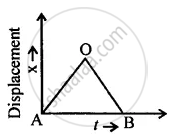
Write down the type of motion of a body along with the A – O – B of the following distance – time graph.
How many variables are present in each equation of motion?
