Advertisements
Advertisements
प्रश्न
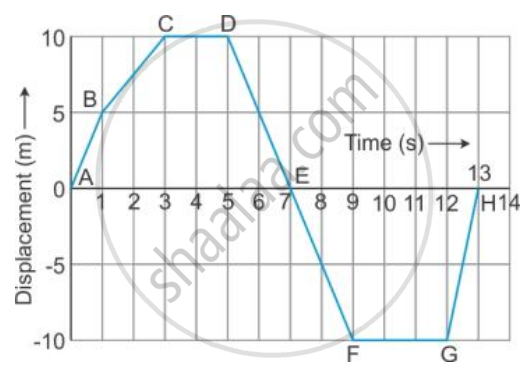
From the displacement-time graph of a cyclist given below in the Figure, find The average velocity in the first 4 s.
Advertisements
उत्तर
Displacement in first 4s = 10 m
Therefore, the average velocity = `"Displacement"/"time"`
= `(10/4)` m/s
= 2.5 m/s-1
APPEARS IN
संबंधित प्रश्न
Arrange the following speed in increasing order (keeping the least speed first):
An athlete running with a speed of 10 m/s.
The graph given alongside shows how the speed of a car changes with time:
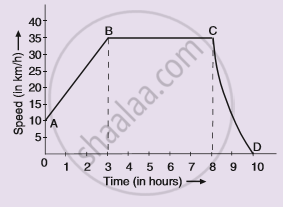
(i) What is the initial speed of the car ?
(ii) What is the maximum speed attained by the car ?
(iii) Which part of the graph shows zero acceleration ?
(iv) Which part of the graph shows varying retardation ?
(v) Find the distance travelled in first 8 hours.
Which of the following can sometimes be 'zero' for a moving body?
(i) average velocity
(ii) distance travelled
(iii) average speed
(iv) displacement
A bus moving along a straight line at 20 m/s undergoes an acceleration of 4 m/s2. After 2 seconds, its speed will be:
Give one example of following motion :
Uniform velocity
The speed of a car is 72 km h-1. Express it in m s-1.
Express 15 m s-1 in km h-1.
Define average velocity and give one example.
What is the relation between distance and time when the body is moving with uniform velocity?
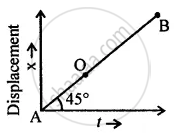
Write down the type of motion of a body along with the A – O – B of the following distance – time graph.