Advertisements
Advertisements
प्रश्न
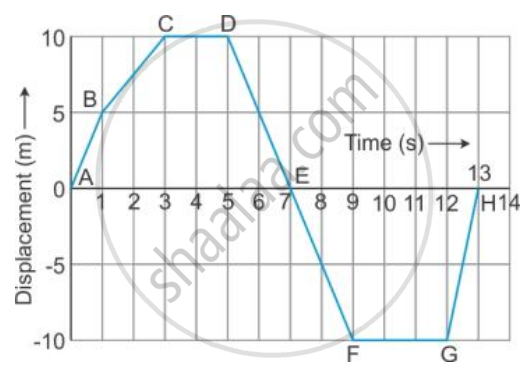
From the displacement-time graph of a cyclist given below in the Figure, find The average velocity in the first 4 s.
Advertisements
उत्तर
Displacement in first 4s = 10 m
Therefore, the average velocity = `"Displacement"/"time"`
= `(10/4)` m/s
= 2.5 m/s-1
APPEARS IN
संबंधित प्रश्न
Joseph jogs from one end A to the other end B of a straight 300 m road in 2 minutes 30 seconds and then turns around and jogs 100 m back to point C in another 1 minute. What are Joseph’s average speeds and velocities in jogging?
- from A to B and
- from A to C?
Abdul, while driving to school, computes the average speed for his trip to be 20 km h−1. On his return trip along the same route, there is less traffic and the average speed is 30 km h−1. What is the average speed for Abdul’s trip?
Arrange the following speed in increasing order (keeping the least speed first
A scooter moving with a speed of 30 km/h.
Convert a speed of 54 km/h into m/s.
A train travels the first 15 km at a uniform speed of 30 km/h; the next 75 km at a uniform speed of 50 km/h; and the last 10 km at a uniform speed of 20 km/h. Calculate the average speed for the entire train journey.
The tip of seconds’ hand of a dock takes 60 seconds to move once on the circular dial of the clock. If the radius of the dial of the clock be 10.5 cm, calculate the speed of the tip of the seconds’ hand of the clock. `("Given" π= 22/7)`.
Express 15 m s-1 in km h-1.
Express the following in m s−1.
1 km h−1
The velocity-time graph of a moving body is given below in Figure
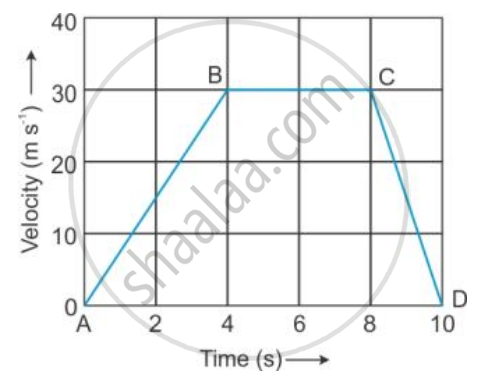
Displacement in each part AB, BC and CD.
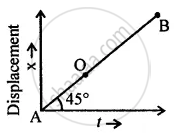
Write down the type of motion of a body along with the A – O – B of the following distance – time graph.