Advertisements
Advertisements
प्रश्न
Figure shows the displacement of a body at different times .
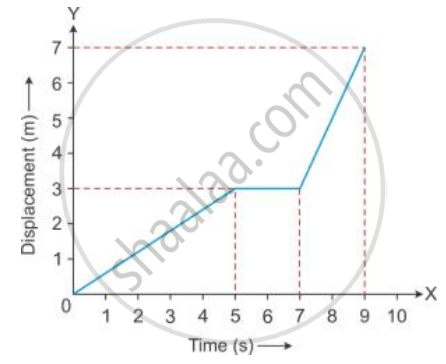
Calculate the average velocity during the time interval 5 s to 9 s ,
[Hint : From 5 s to 9 s , displacement = 7 m - 3m = 4m]
Advertisements
उत्तर
From, 5 s to 9 s , displacement = 7m - 3m = 4m.
Time elapsed between 5 s to 9 s = 4 s
Average velocity = Displacement/time
= (4/4) m/s
= 1 m/s-1
APPEARS IN
संबंधित प्रश्न
Change the speed of 6 m/s into km/h.
Arrange the following speed in increasing order (keeping the least speed first):
An athlete running with a speed of 10 m/s.
A tortoise moves a distance of 100 metres in 15 minutes. What is the average speed of tortoise in km/h ?
A train travels the first 15 km at a uniform speed of 30 km/h; the next 75 km at a uniform speed of 50 km/h; and the last 10 km at a uniform speed of 20 km/h. Calculate the average speed for the entire train journey.
A train starting from rest moves with a uniform acceleration of 0.2 m/s2 for 5 minutes. Calculate the speed acquired and the distance travelled in this time.
The tip of seconds’ hand of a dock takes 60 seconds to move once on the circular dial of the clock. If the radius of the dial of the clock be 10.5 cm, calculate the speed of the tip of the seconds’ hand of the clock. `("Given" π= 22/7)`.
Give one example of following motion :
Variable velocity
Express the following in m s-1.
18 km min-1
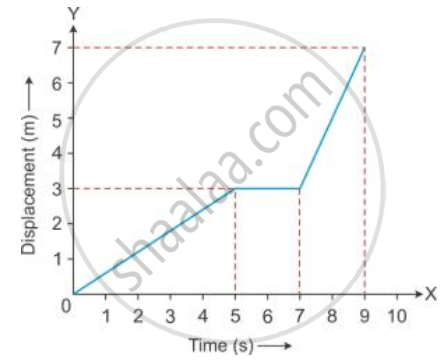
Figure shows the displacement of a body at different times .
Calculate the velocity of the body as it moves for time interval :
(i) 0 to 5 s,
(ii) 5 s to 7 s
(iii) 7 s to 9 s.
Define speed of a body.
