Advertisements
Advertisements
प्रश्न
A speeding car changes its velocity from 108 kmh−1 to 36 kmh−1 in 4 s. Calculate its deceleration in
- ms−2
- kmh−2.
Advertisements
उत्तर
Initial velocity = u = 108 kmh−1
u = `108xx5/18` m−1
u = 30 ms−1
Final velocity = v = 36 kmh−1
v = `36xx5/18` ms−1
v = 10 ms−1
Time = t = 4 S
Deceleration = a = `("v"-"u")/"t"`
a = `(10-30)/4`
a = `-20/4` = −5 ms−2
a = `(-5xx3600xx3600)/1000` kmh−2 = −64800 kmh−2
APPEARS IN
संबंधित प्रश्न
In addition to speed, what else should we know to predict the position of a moving body ?
A snail covers a distance of 100 metres in 50 hours. Calculate the average speed of snail in km/h.
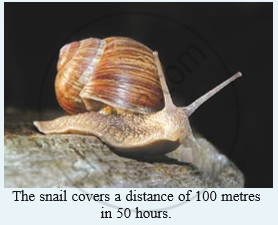
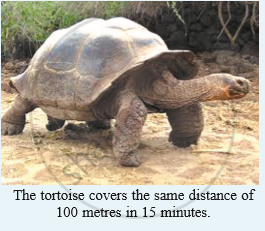
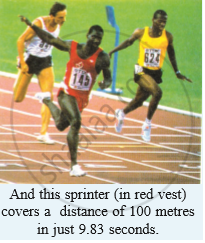
A car travels 100 km at a speed of 60 km/h and returns with a speed of 40 km/h. Calculate the average speed for the whole journey.
Write the formula to calculate the speed of a body moving along a circular path. Give the meaning of each symbol which occurs in it.
Which of the following could not be a unit of speed?
A bus moving along a straight line at 20 m/s undergoes an acceleration of 4 m/s2. After 2 seconds, its speed will be:
Give one example of following motion :
Uniform velocity
Express 15 m s-1 in km h-1.
Draw the shape of the velocity-time graph for a body moving with (a) Uniform velocity and (b) Uniform acceleration.
How many variables are present in each equation of motion?
