Advertisements
Advertisements
प्रश्न
Multiple choice Question. Select the correct option.
A graph is a straight line parallel to the time axis in a distance-time graph. From the graph, it implies:
विकल्प
body is stationary
body is moving with a uniform speed
body is moving with a variable speed
none of these
Advertisements
उत्तर
body is stationary
APPEARS IN
संबंधित प्रश्न
Derive the following equation of motion by the graphical method : v2 = u2 + 2as, where the symbols have their usual meanings.
Draw displacement – time graph for the following situation:
When a body is stationary.
Diagram shows a velocity – time graph for a car starting from rest. The graph has three sections AB, BC, and CD.
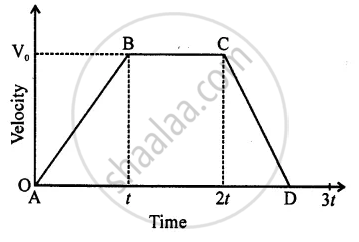
Is the magnitude of acceleration higher or lower than that of retardation? Give a reason.
From the velocity – time graph given below, calculate Average velocity in region CED.
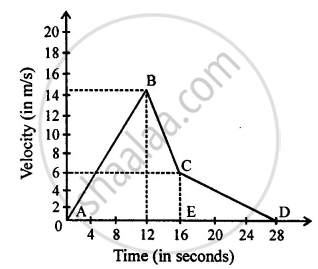
How does the slope of a speed-time graph give the acceleration of a body moving along a straight line?
What can you conclude if the speed-time graph of a body is a curve moving upwards starting from the origin?
What can you say about the motion of a body if:
Its time-velocity graph is a straight line
What does the slope of velocity-time graph represent?
Sketch the shape of the velocity-time graph for a body moving with:
Uniformly velocity
The area under velocity – time graph represents the ______
