Advertisements
Advertisements
प्रश्न
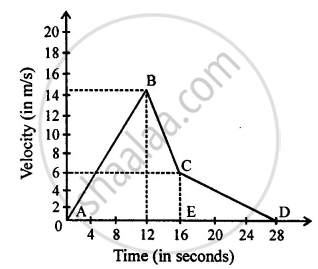
From the velocity – time graph given below, calculate Average velocity in region CED.
Advertisements
उत्तर
Displacement covered in region ΔCDE = area of ΔCDE
= `1/2xx"ED"xx"CE"`
= `1/2xx(28-16)xx6`
= `1/2xx12xx6`
= 36 m
Average velocity in region CED = `"Total displacement"/"Time"`
= `36/12`
= 3 ms−1
APPEARS IN
संबंधित प्रश्न
Fill in the following blank with suitable word :
In a speed-time graph, the area enclosed by the speed-time curve and the time axis gives the…………….. by the body.
Show by using the graphical method that: `s=ut+1/2at^2` where the symbols have their usual meanings.
The speed-time graph of an ascending passenger lift is given alongside. What is the acceleration of the lift:
(1) during the first two seconds ?
(2) between second and tenth second ?
(3) during the last two seconds ?
A body at rest is thrown downward from the top of the tower. Draw a distance – time graph of its free fall under gravity during the first 3 seconds. Show your table of values starting t = 0 with an interval of 1 second, (g = 10 ms−2).
The graph of one quantity versus another result in a straight line. How are the quantities related to each other?
What can you conclude if the speed-time graph of a body is a straight line sloping upwards and not passing through the origin?
Figure shows displacement- time graph of two objects A and B moving in a stra ight line. Which object is moving fa ster?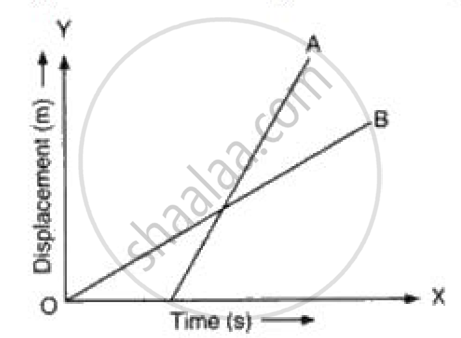
What can you say about the nature of motion of a body of its displacement-time graph is:
A straight line parallel to line axis?
Draw the distance-time graphs of the bodies P and Q starting from rest, moving with uniform speeds with P moving faster than Q.
Which of the following can determine the acceleration of a moving object.
