Advertisements
Advertisements
Question
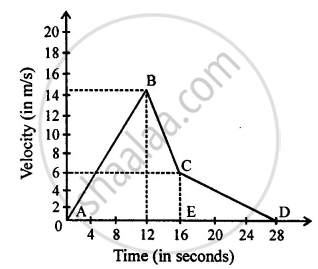
From the velocity – time graph given below, calculate Average velocity in region CED.
Advertisements
Solution
Displacement covered in region ΔCDE = area of ΔCDE
= `1/2xx"ED"xx"CE"`
= `1/2xx(28-16)xx6`
= `1/2xx12xx6`
= 36 m
Average velocity in region CED = `"Total displacement"/"Time"`
= `36/12`
= 3 ms−1
APPEARS IN
RELATED QUESTIONS
What can you say about the motion of a body if:
its velocity-time graph is a straight line ?
Three speed-time graphs are given below :
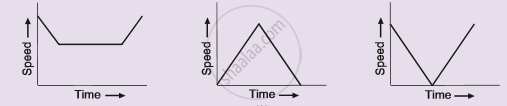
Which graph represents the case of:
(i) a cricket ball thrown vertically upwards and returning to the hands of the thrower ?
(ii) a trolley decelerating to a constant speed and then accelerating uniformly ?
Study the speed-time graph of a car given alongside and answer the following questions:
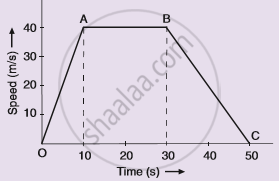
(i) What type of motion is represented by OA ?
(ii) What type of motion is represented by AB ?
(iii) What type of motion is represented by BC ?
(iv) What is the acceleration of car from O to A ?
(v)What is the acceleration of car from A to B ?
(vi) What is the retardation of car from B to C ?
Draw a velocity-time graph for the free fall of a body under gravity starting from rest. Take g = 10m s-2
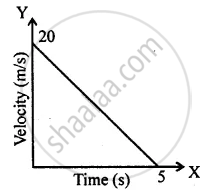
Multiple choice Question. Select the correct option.
The distance covered in the adjoining velocity-time graph is :
Draw velocity – time graph for the following situation:
When a body, is moving with uniform velocity.
Draw velocity – time graph for the following situation:
When a body is moving with variable velocity, but uniform acceleration.
How will you use a speed-time graph to find whether the acceleration of the body is uniform or not?
Figure shows displacement- time graph of two objects A and B moving in a stra ight line. Which object is moving fa ster?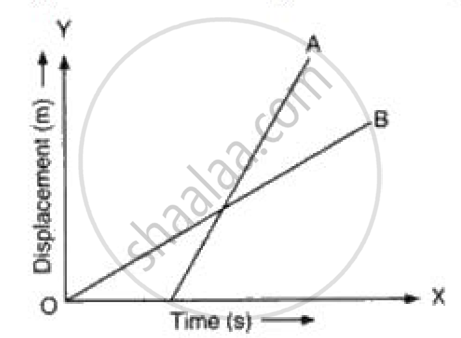
Draw the distance-time graphs of the bodies P and Q starting from rest, moving with uniform speeds with P moving faster than Q.
