Advertisements
Advertisements
Question
Draw displacement – time graph for the following situation:
When a body is stationary.
Advertisements
Solution
Displacement – time graph when a body is stationary.

APPEARS IN
RELATED QUESTIONS
The speed-time graph of an ascending passenger lift is given alongside. What is the acceleration of the lift:
(1) during the first two seconds ?
(2) between second and tenth second ?
(3) during the last two seconds ?
For uniform motion _________
Multiple choice Question. Select the correct option.
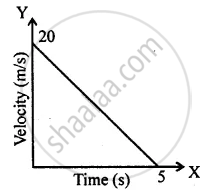
The distance covered in the adjoining velocity-time graph is :
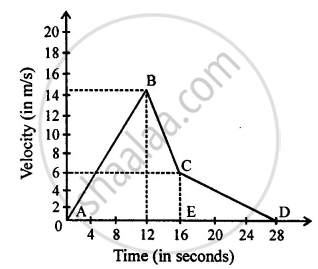
From the velocity – time graph given below, calculate Distance covered in the region ABCE.
The area of the right triangle under a speed-time graph is 500 m, in a time interval of 20 s. What is the speed of the body? Is the motion uniform or non-uniform?
Figure shows the distance-time graph of three students A, B and C. On the basis of the graph, answer the following :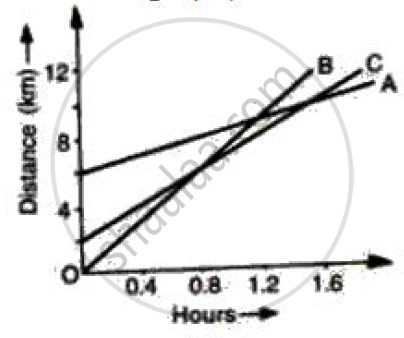
Will the three ever meet at any point on the road?
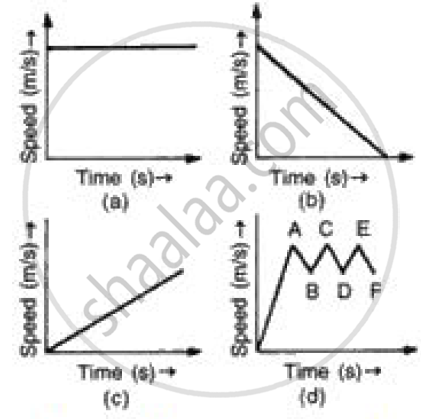
(i) In speed time graph uniform motion is given by a straight line parallel to x axis so figure (a) denotes the uniform motion.
(ii) In speed time graph motion with increasing speed is shown by straight line with positive slope so figure (c) denotes the motion with speed increasing.
(iii) In speed time graph motion with decreasing speed is shown by straight line with negative slope so figure (b) denotes the motion with speed decreasing.
(iv) In speed time graph motion with oscillating speed is shown by zigzag line so figure {d) denotes the motion with speed oscillating.
Saphira moves at a constant speed in the same direction. Rephrase the same sentence in fewer words using concepts related to motion.
The area under velocity – time graph represents the ______
State whether true or false. If false, correct the statement.
If the velocity – time graph of a particle is a straight line inclined to X-axis then its displacement – time graph will be a straight line.
