Advertisements
Advertisements
प्रश्न
Draw displacement – time graph for the following situation:
When a body is stationary.
Advertisements
उत्तर
Displacement – time graph when a body is stationary.

APPEARS IN
संबंधित प्रश्न
What type of motion is represented by the following graph ?
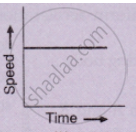
What type of motion is represented by the following graph ?
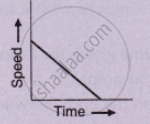
What does the area of an acceleration – time graph represent?
Draw velocity – time graph for the following situation:
When a body, is moving with uniform velocity.
Draw velocity – time graph for the following situation:
When a body is moving with variable velocity, but uniform acceleration.
A train starting from rest picks up a speed of 20 ms−1 in 200 s. It continues to move at the same rate for the next 500 s and is then brought to rest in another 100 s.
- Plot a speed-time graph.
- From graph calculate
(a) uniform rate of acceleration
(b) uniform rate of retardation
(c) total distance covered before stopping
(d) average speed.
Represent the position of a body described as at 15 m, 30o north of west, on a graph paper.
Draw the following graph:
Distance versus time for a body at rest.
Its time-displacement graph is a straight line.
State whether true or false. If false, correct the statement.
The velocity – time graph of a particle falling freely under gravity would be a straight line parallel to the x axis.
