Advertisements
Advertisements
प्रश्न
Draw a velocity-time graph for the free fall of a body under gravity starting from rest. Take g = 10m s-2
Advertisements
उत्तर
Below is the velocity-time graph for the free fall of a body under gravity, starting from rest:

APPEARS IN
संबंधित प्रश्न
What can you say about the motion of a body if its speed-time graph is a straight line parallel to the time axis ?
Draw a displacement-time graph for a boy going to school with uniform velocity.
Diagram shows a velocity – time graph for a car starting from rest. The graph has three sections AB, BC, and CD.
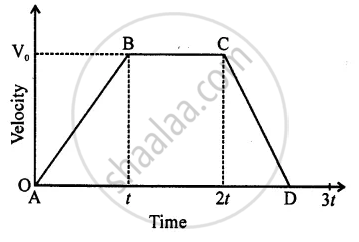
In which section, car has a zero acceleration?
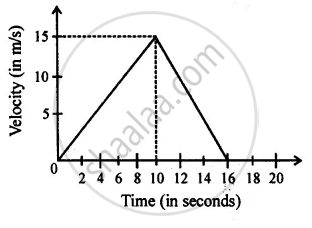
From the diagram given below, calculate distance covered by body.
The area of the right triangle under a speed-time graph is 500 m, in a time interval of 20 s. What is the speed of the body? Is the motion uniform or non-uniform?
Given below are the speed -time graphs. Match them with their corresponding motions :
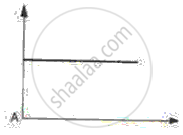 |
(a) Uniformity retared motion |
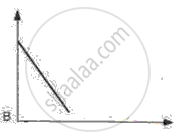 |
(b) Non-uniformity acceleration |
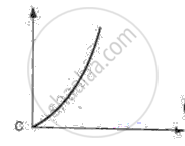 |
(c) Non-uniform motion |
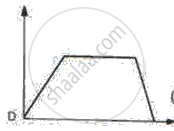 |
(d) uniform motion |
Which of the following graphs represents a motion with negative acceleration?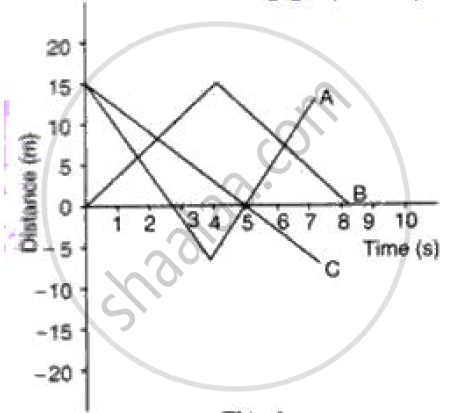
Draw distance-time graph to show:
Decreasing velocity
Draw velocity-time graph to show:
Acceleration
Write a sentence to explain the shape of graph.
An object is moving in a positive direction with positive acceleration. The velocity-time graph with constant acceleration which represents the above situation is:
