Advertisements
Advertisements
प्रश्न
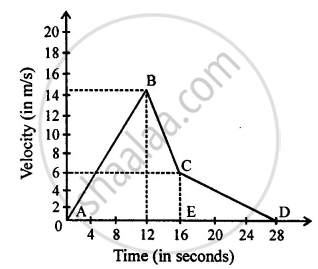
From the velocity – time graph given below, calculate Distance covered in the region ABCE.
Advertisements
उत्तर
Distance covered in region ABCE = ar(ΔABF) + area of trapezium BCEF
= `1/2xx"AF"xx"BF"+1/2("BF+CF")xx"GC"`
= `1/2xx12xx14+1/2(14+6)xx4`
= 6 × 14 + 10 × 4
= 84 + 40
= 124 m
APPEARS IN
संबंधित प्रश्न
The velocity-time graph for part of a train journey is a horizontal straight line. What does this tell you about its acceleration ?
Derive the following equation of motion by the graphical method : v2 = u2 + 2as, where the symbols have their usual meanings.
What can you say about the motion of a body if:
its velocity-time graph is a straight line ?
For uniform motion _________
Diagram shows a velocity – time graph for a car starting from rest. The graph has three sections AB, BC, and CD.
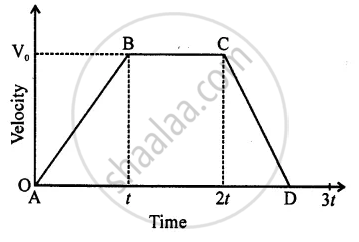
Is the magnitude of acceleration higher or lower than that of retardation? Give a reason.
A train starting from rest picks up a speed of 20 ms−1 in 200 s. It continues to move at the same rate for the next 500 s and is then brought to rest in another 100 s.
- Plot a speed-time graph.
- From graph calculate
(a) uniform rate of acceleration
(b) uniform rate of retardation
(c) total distance covered before stopping
(d) average speed.
The graph of one quantity versus another result in a straight line. How are the quantities related to each other?
What can you say about the nature of motion of a body of its displacement-time graph is:
A straight line parallel to line axis?
Draw distance-time graph to show:
Decreasing velocity
Figure shows the distance-time graph of three students A, B and C. On the basis of the graph, answer the following :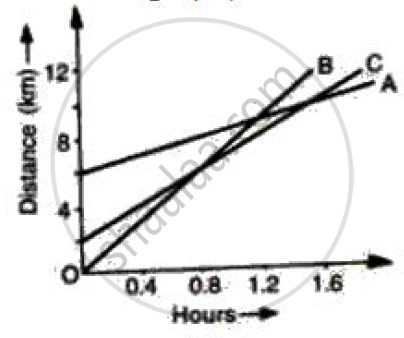
Which of the three is traveling the fastest?
