Advertisements
Advertisements
प्रश्न
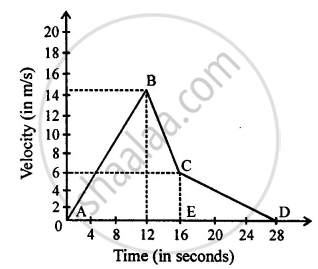
From the velocity – time graph given below, calculate Distance covered in the region ABCE.
Advertisements
उत्तर
Distance covered in region ABCE = ar(ΔABF) + area of trapezium BCEF
= `1/2xx"AF"xx"BF"+1/2("BF+CF")xx"GC"`
= `1/2xx12xx14+1/2(14+6)xx4`
= 6 × 14 + 10 × 4
= 84 + 40
= 124 m
APPEARS IN
संबंधित प्रश्न
What can you say about the motion of a body if its speed-time graph is a straight line parallel to the time axis ?
Show by using the graphical method that: `s=ut+1/2at^2` where the symbols have their usual meanings.
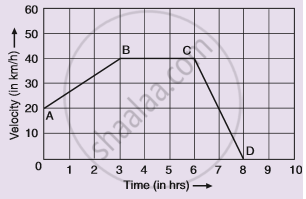
Given alongside is the velocity-time graph for a moving body :
Find :
(i) Velocity of the body at point C.
(ii) Acceleration acting on the body between A and B.
(iii) Acceleration acting on the body between B and C.
Draw a velocity-time graph for the free fall of a body under gravity starting from rest. Take g = 10m s-2
Multiple choice Question. Select the correct option.
The slope of displacement – time graph represents.
Draw velocity – time graph for the following situation:
When a body is moving with variable velocity, but uniform acceleration.
How does the slope of a speed-time graph give the acceleration of a body moving along a straight line?
Sketch the shape of the velocity-time graph for a body moving with:
Uniformly velocity
Figure shows the distance-time graph of three students A, B and C. On the basis of the graph, answer the following :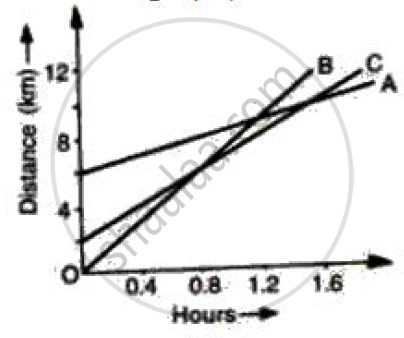
Will the three ever meet at any point on the road?
The area under the v-t graph represents a physical quantity that has the unit.
