Advertisements
Advertisements
प्रश्न
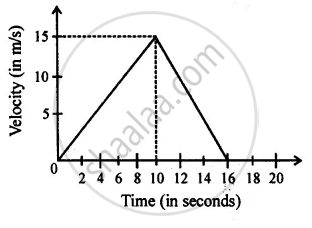
From the diagram given below, calculate distance covered by body.
Advertisements
उत्तर

Distance covered = area under v.t. graph
= area of ΔOAC + area of ΔABC
= `1/2xx"OC"xx"AC"+1/2xx"BC"xx"AC"`
= `1/2xx10xx15+1/2xx6xx15`
= 5 × 15 + 3 × 15
= 75 + 45
= 120 m
APPEARS IN
संबंधित प्रश्न
Fill in the following blank with suitable word :
In a speed-time graph, the area enclosed by the speed-time curve and the time axis gives the…………….. by the body.
Show by using the graphical method that: `s=ut+1/2at^2` where the symbols have their usual meanings.
What type of motion is represented by the following graph ?
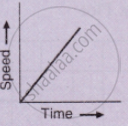
The area under a speed-time graph in a given intervals gives the total distance covered by a body irrespective of its motion being uniform or non-uniform.
How will you use a speed-time graph to find whether the acceleration of the body is uniform or not?
Derive the equation
S = ut+ `1/2` at2
Using a speed- time graph
Draw the distance-time graphs of the bodies P and Q starting from rest, moving with uniform speeds with P moving faster than Q.
Figure shows the distance-time graph of three students A, B and C. On the basis of the graph, answer the following :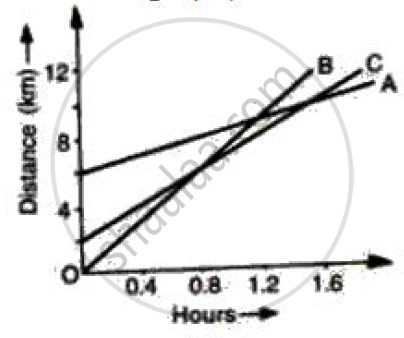
When B meets A, where is C?
An object is moving in a positive direction with positive acceleration. The velocity-time graph with constant acceleration which represents the above situation is:
The velocity-displacement graph describing the motion of a bicycle is shown in the figure.

The acceleration-displacement graph of the bicycle's motion is best described by:
