Advertisements
Advertisements
प्रश्न
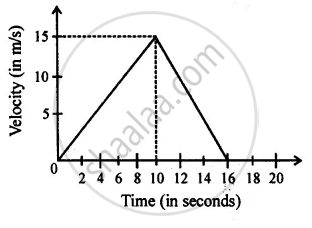
From the diagram given below, calculate distance covered by body.
Advertisements
उत्तर

Distance covered = area under v.t. graph
= area of ΔOAC + area of ΔABC
= `1/2xx"OC"xx"AC"+1/2xx"BC"xx"AC"`
= `1/2xx10xx15+1/2xx6xx15`
= 5 × 15 + 3 × 15
= 75 + 45
= 120 m
APPEARS IN
संबंधित प्रश्न
What does the slope of a displacement-time graph represent?
Diagram shows a velocity – time graph for a car starting from rest. The graph has three sections AB, BC and CD.
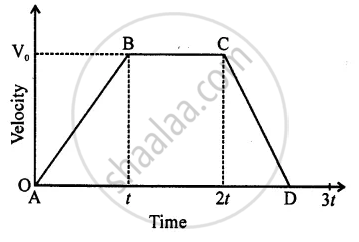
Compare the distance travelled in section BC with the distance travelled in section AB.
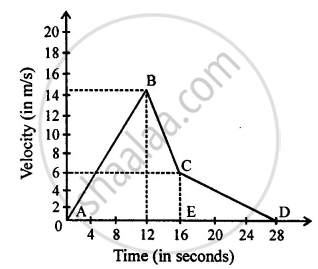
From the velocity – time graph given below, calculate Average velocity in region CED.
How will you use a speed-time graph to find whether the acceleration of the body is uniform or not?
Given on th e side are a few speed - time graphs for various objects moving along a stra ight line. Refer below figure. (a), (b), (c) and (d).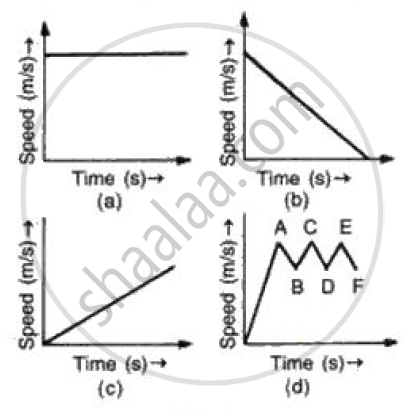
Which of these graphs represent
(a) Uni form motion
(b) Motion with speed increasing
(c) Motion with speed decreasing and
(d) Motion with speed oscillating.?
Interpret the following graph: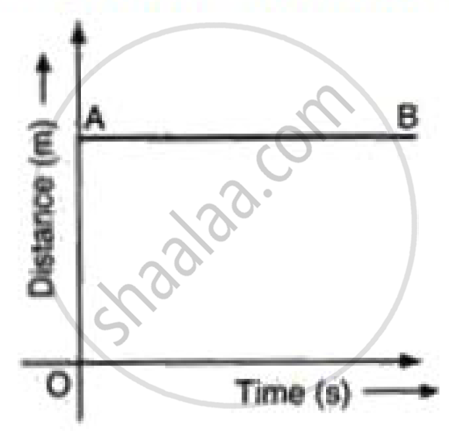
Saphira moves at a constant speed in the same direction. Rephrase the same sentence in fewer words using concepts related to motion.
From the v-t graph, ______ can be calculated.
The given graph shows the variation of velocity (v) with position (x) for a particle moving along a straight line
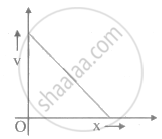
Which of the following graph shows the variation of acceleration (a) with position (x)?
The velocity-displacement graph describing the motion of a bicycle is shown in the figure.

The acceleration-displacement graph of the bicycle's motion is best described by:
