Advertisements
Advertisements
प्रश्न
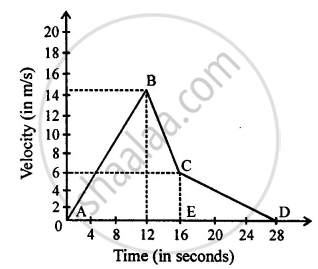
From the velocity – time graph given below, calculate acceleration in the region AB.
Advertisements
उत्तर
Acceleration in the region AB = Slope of v.t. graph from A to B
= `"BF"/"AF"=14/12` = 1.16 ms−2
APPEARS IN
संबंधित प्रश्न
A body with an initial velocity x moves with a uniform acceleration y. Plot its velocity-time graph.
What type of motion is represented by the following graph ?
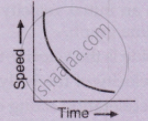
Diagram shows a velocity – time graph for a car starting from rest. The graph has three sections AB, BC and CD.
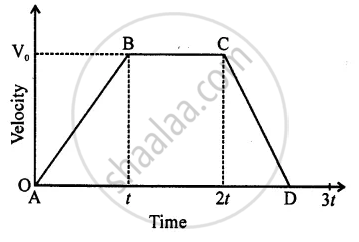
Compare the distance travelled in section BC with the distance travelled in section AB.
Diagram shows a velocity – time graph for a car starting from rest. The graph has three sections AB, BC, and CD.
Is the magnitude of acceleration higher or lower than that of retardation? Give a reason.
A train starting from rest picks up a speed of 20 ms−1 in 200 s. It continues to move at the same rate for the next 500 s and is then brought to rest in another 100 s.
- Plot a speed-time graph.
- From graph calculate
(a) uniform rate of acceleration
(b) uniform rate of retardation
(c) total distance covered before stopping
(d) average speed.
The area of the right triangle under a speed-time graph is 500 m, in a time interval of 20 s. What is the speed of the body? Is the motion uniform or non-uniform?
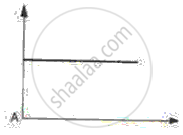
Given below are the speed -time graphs. Match them with their corresponding motions :
 |
(a) Uniformity retared motion |
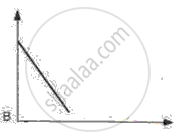 |
(b) Non-uniformity acceleration |
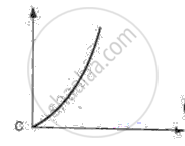 |
(c) Non-uniform motion |
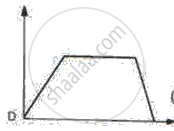 |
(d) uniform motion |
Draw distance-time graph to show:
Decreasing velocity
Figure shows the distance-time graph of three students A, B and C. On the basis of the graph, answer the following :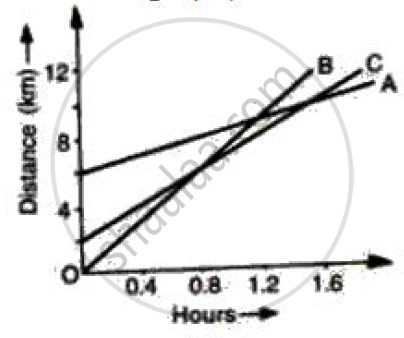
Which of the three is traveling the fastest?
The area of the velocity-time graph gives the displacement of the body.
