Advertisements
Advertisements
प्रश्न
State whether true or false. If false, correct the statement.
If the velocity – time graph of a particle is a straight line inclined to X-axis then its displacement – time graph will be a straight line.
पर्याय
True
False
Advertisements
उत्तर
If the velocity – time graph of a particle is a straight line inclined to X-axis then its displacement – time graph will be a straight line- True
APPEARS IN
संबंधित प्रश्न
Study the speed-time graph of a car given alongside and answer the following questions:
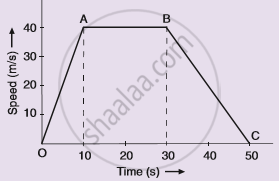
(i) What type of motion is represented by OA ?
(ii) What type of motion is represented by AB ?
(iii) What type of motion is represented by BC ?
(iv) What is the acceleration of car from O to A ?
(v)What is the acceleration of car from A to B ?
(vi) What is the retardation of car from B to C ?
What type of motion is represented by the following graph ?
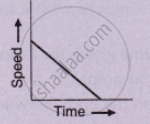
What does the slope of a displacement-time graph represent?
What does the slope of speed-time graph indicate?
What can you say about the motion of a body if:
Its time-velocity graph is a straight line
Draw distance-time graph to show:
Uniform velocity
Draw velocity-time graph to show:
Deceleration
Write a sentence to explain the shape of graph.
Figure shows the velocity-time graphs for two objects A and B moving in same direction . Which object has the greater a cceleration?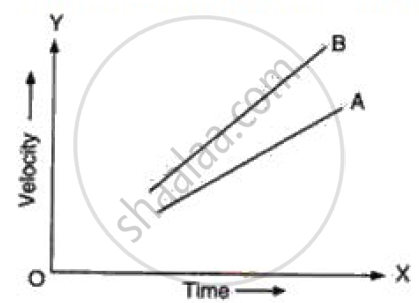
Draw the distance-time graphs of the bodies P and Q starting from rest, moving with uniform speeds with P moving faster than Q.
Figure shows the distance-time graph of three students A, B and C. On the basis of the graph, answer the following :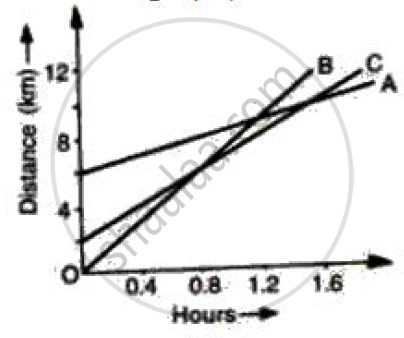
When B meets A, where is C?
