Advertisements
Advertisements
प्रश्न
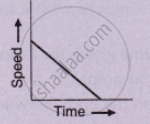
What type of motion is represented by the following graph ?
Advertisements
उत्तर
Graph (c) represents uniformly retarding motion as it has a constant negative slope.
APPEARS IN
संबंधित प्रश्न
What can you say about the motion of a body if:
its displacement-time graph is a straight line ?
What does the slope of a displacement-time graph represent?
Draw velocity – time graph for the following situation:
When a body, is moving with uniform velocity.
Draw the following graph:
Speed versus time for a non-uniform acceleration.
Draw the following graph:
Distance versus time for a body at rest.
Draw velocity-time graph to show:
Acceleration
Write a sentence to explain the shape of graph.
Interpret the following graph: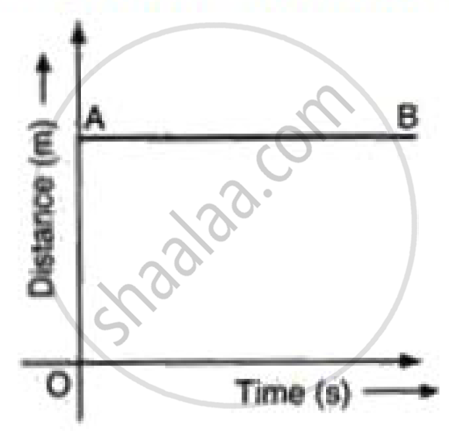
Figure shows the distance-time graph of three students A, B and C. On the basis of the graph, answer the following :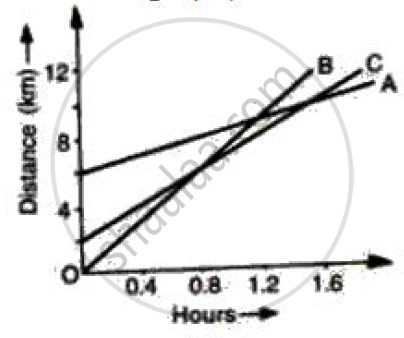
Will the three ever meet at any point on the road?
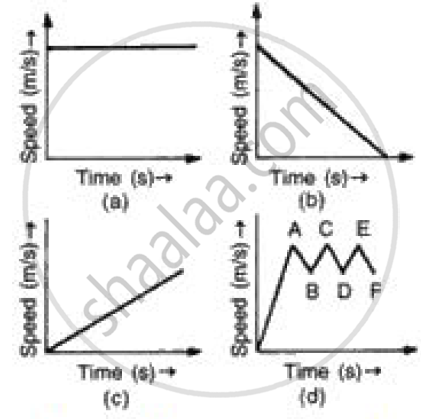
(i) In speed time graph uniform motion is given by a straight line parallel to x axis so figure (a) denotes the uniform motion.
(ii) In speed time graph motion with increasing speed is shown by straight line with positive slope so figure (c) denotes the motion with speed increasing.
(iii) In speed time graph motion with decreasing speed is shown by straight line with negative slope so figure (b) denotes the motion with speed decreasing.
(iv) In speed time graph motion with oscillating speed is shown by zigzag line so figure {d) denotes the motion with speed oscillating.
The given graph shows the variation of velocity (v) with position (x) for a particle moving along a straight line
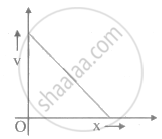
Which of the following graph shows the variation of acceleration (a) with position (x)?
