मराठी
तामिळनाडू बोर्ड ऑफ सेकेंडरी एज्युकेशनएस.एस.एल.सी. (इंग्रजी माध्यम) इयत्ता ९

State whether true or false. If false, correct the statement. The velocity – time graph of a particle falling freely under gravity would be a straight line parallel to the x axis. - Science

Advertisements
Advertisements

प्रश्न

State whether true or false. If false, correct the statement.

The velocity – time graph of a particle falling freely under gravity would be a straight line parallel to the x axis.

पर्याय

  • True

  • False

MCQ
चूक किंवा बरोबर
Advertisements

उत्तर

False,

Correct statement: The velocity time graph of a particle falling freely under gravity would be a straight line perpendicular to the x axis.

shaalaa.com
  या प्रश्नात किंवा उत्तरात काही त्रुटी आहे का?
पाठ 2: Motion - Exercise [पृष्ठ २४]

APPEARS IN

सामाचीर कलवी Science [English] Class 9 TN Board
पाठ 2 Motion
Exercise | Q III. 4. | पृष्ठ २४

संबंधित प्रश्‍न

Draw a velocity-time graph to show the following motion :
A car accelerates uniformly from rest for 5 s ; then it travels at a steady’ velocity for 5 s.


What can you say about the motion of a body if:
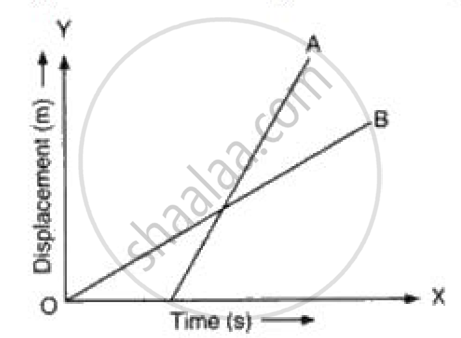
its displacement-time graph is a straight line ?


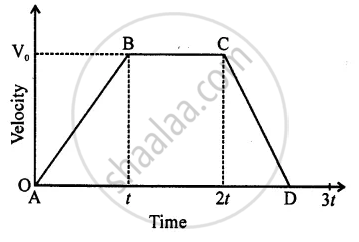
Study the speed-time graph of a car given alongside and answer the following questions:

(i) What type of motion is represented by OA ?
(ii) What type of motion is represented by AB ?
(iii) What type of motion is represented by BC ?
(iv) What is the acceleration of car from O to A ?
(v)What is the acceleration of car from A to B ?
(vi) What is the retardation of car from B to C ?


A car of mass 1000 kg is moving with a velocity of 10 m s−1. If the velocity-time graph for this car is a horizontal line parallel to the time axis, then the velocity of car at the end of 25 s will be :


Multiple choice Question. Select the correct option.

The distance covered in the adjoining velocity-time graph is :


A train starting from rest picks up a speed of 20 ms−1 in 200 s. It continues to move at the same rate for the next 500 s and is then brought to rest in another 100 s.

  1. Plot a speed-time graph.
  2. From graph calculate
    (a) uniform rate of acceleration
    (b) uniform rate of retardation
    (c) total distance covered before stopping
    (d) average speed.

What can you say about the motion of a body if:
Its time-velocity graph is a straight line


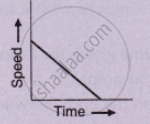
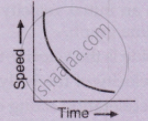
(i) In speed time graph uniform motion is given by a straight line parallel to x axis so figure (a) denotes the uniform motion.
(ii) In speed time graph motion with increasing speed is shown by straight line with positive slope so figure (c) denotes the motion with speed increasing.
(iii) In speed time graph motion with decreasing speed is shown by straight line with negative slope so figure (b) denotes the motion with speed decreasing.
(iv) In speed time graph motion with oscillating speed is shown by zigzag line so figure {d) denotes the motion with speed oscillating.


The area under the v-t graph represents a physical quantity that has the unit.


The given graph shows the variation of velocity (v) with position (x) for a particle moving along a straight line


Which of the following graph shows the variation of acceleration (a) with position (x)?


Share
Notifications

Englishहिंदीमराठी


      Forgot password?
Use app×