Advertisements
Advertisements
प्रश्न
Derive the equation
S = ut+ `1/2` at2
Using a speed- time graph
Advertisements
उत्तर

The area enclosed under a velocity time curve gives the distance covered by a moving body. So total distance S covered by a uniformly accelerating body is given by area of trapezium OSQP.
S = area of trapezium OSQP.
AREA of rectangle OSRP + area of triangle PRQ.
S = OP x OS + `1/2` PR xQR.
s = u x t + `1/2` x t x at
S = ut + `1/2` at2
This is known as second equation of motion.
APPEARS IN
संबंधित प्रश्न
What can you say about the motion of a body if its speed-time graph is a straight line parallel to the time axis ?
Draw a displacement-time graph for a boy going to school with uniform velocity.
Draw displacement – time graph for the following situation:
When a body is stationary.
Diagram shows a velocity – time graph for a car starting from rest. The graph has three sections AB, BC, and CD.
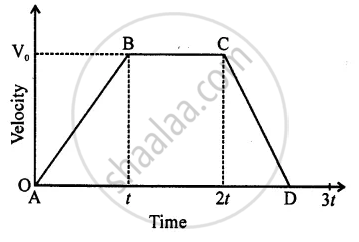
In which section, car has a zero acceleration?
A ball is thrown up vertically and returns back to thrower in 6 s. Assuming there is no air friction, plot a graph between velocity and time. From the graph calculate
- deceleration
- acceleration
- total distance covered by ball
- average velocity.
The area under a speed-time graph in a given intervals gives the total distance covered by a body irrespective of its motion being uniform or non-uniform.
Given on th e side are a few speed - time graphs for various objects moving along a stra ight line. Refer below figure. (a), (b), (c) and (d).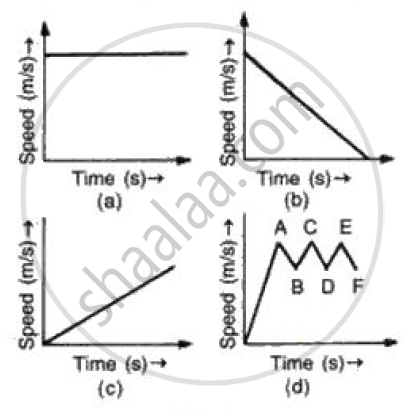
Which of these graphs represent
(a) Uni form motion
(b) Motion with speed increasing
(c) Motion with speed decreasing and
(d) Motion with speed oscillating.?
Which of the following graphs represents a motion with negative acceleration?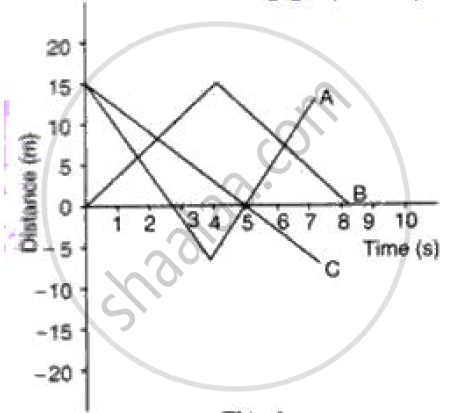
State whether true or false. If false, correct the statement.
The velocity – time graph of a particle falling freely under gravity would be a straight line parallel to the x axis.
A straight line parallel to the x-axis in the velocity-time graph represents the object moving in ______.
