Advertisements
Advertisements
प्रश्न
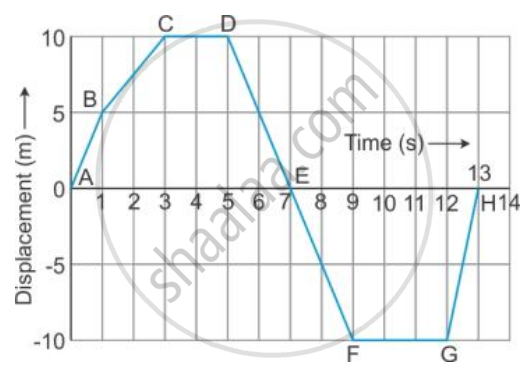
From the displacement-time graph of a cyclist given below in the Figure, find The time after which he reaches the starting point .
Advertisements
उत्तर
The starting point is where displacement = 0 m.
Looking at the graph:
The cyclist starts at point A (0 m at 0 s).
He returns to 0 m at point E at 7 s.
Again, he crosses 0 m at point H at 13 s.
The cyclist reaches the starting point (displacement = 0) at 7 seconds and 13 seconds.
So the first time he returns to the starting point is 7 seconds later.
APPEARS IN
संबंधित प्रश्न
What can you say about the motion of a body if its speed-time graph is a straight line parallel to the time axis ?
Derive the following equation of motion by the graphical method : v2 = u2 + 2as, where the symbols have their usual meanings.
The area under a speed-time graph in a given intervals gives the total distance covered by a body irrespective of its motion being uniform or non-uniform.
The area of the right triangle under a speed-time graph is 500 m, in a time interval of 20 s. What is the speed of the body? Is the motion uniform or non-uniform?
The graph of one quantity versus another result in a straight line. How are the quantities related to each other?
Draw the following graph:
Speed versus time for a non-uniform acceleration.
What can you say about the nature of motion of a body of its displacement-time graph is:
A straight line parallel to line axis?
Figure shows the velocity-time graphs for two objects A and B moving in same direction . Which object has the greater a cceleration?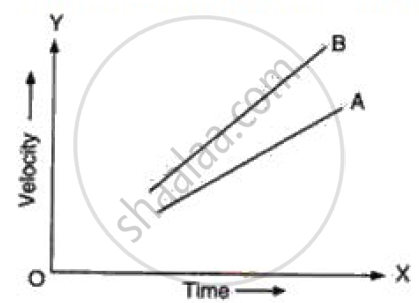
Saphira moves at a constant speed in the same direction. Rephrase the same sentence in fewer words using concepts related to motion.
Which of the following can determine the acceleration of a moving object.
