Advertisements
Advertisements
प्रश्न
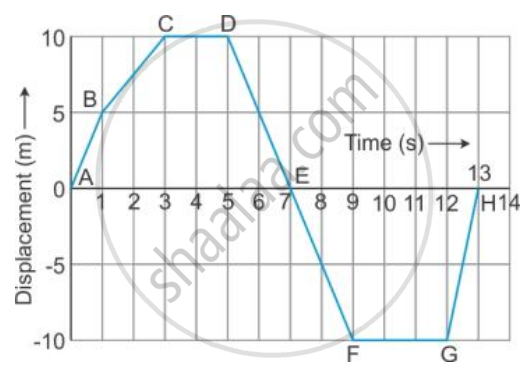
From the displacement-time graph of a cyclist given below in the Figure, find The time after which he reaches the starting point .
Advertisements
उत्तर
The starting point is where displacement = 0 m.
Looking at the graph:
The cyclist starts at point A (0 m at 0 s).
He returns to 0 m at point E at 7 s.
Again, he crosses 0 m at point H at 13 s.
The cyclist reaches the starting point (displacement = 0) at 7 seconds and 13 seconds.
So the first time he returns to the starting point is 7 seconds later.
APPEARS IN
संबंधित प्रश्न
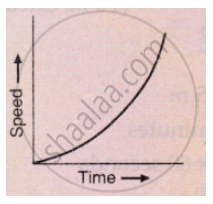
What conclusion can you draw about the acceleration of a body from the speed-time graph shown below .
The velocity-time graph for part of a train journey is a horizontal straight line. What does this tell you about its acceleration ?
Multiple choice Question. Select the correct option.
In the velocity-time graph, the acceleration is
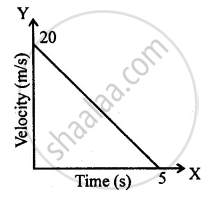
From the velocity – time graph given below, calculate acceleration in the region AB.
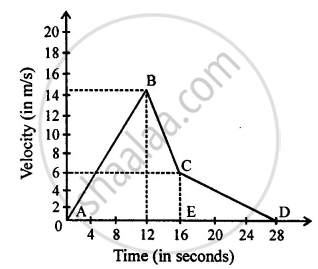
What can you conclude if the speed-time graph of a body is a curve moving upwards starting from the origin?
Draw the following graph:
Speed versus time for a non-uniform acceleration.
Figure shows displacement- time graph of two objects A and B moving in a stra ight line. Which object is moving fa ster?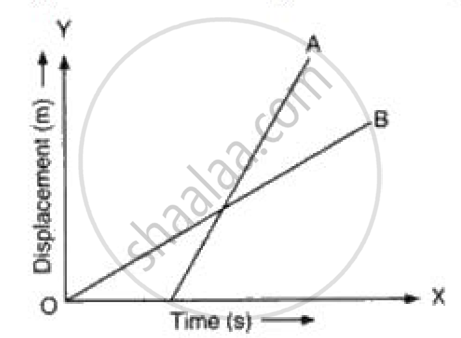
Its time-displacement graph is a straight line.
Draw distance-time graph to show:
Increasing velocity
The given graph shows the variation of velocity (v) with position (x) for a particle moving along a straight line
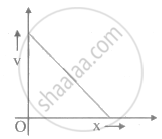
Which of the following graph shows the variation of acceleration (a) with position (x)?
