Advertisements
Advertisements
प्रश्न
What can you say about the motion of a body if:
its displacement-time graph is a straight line ?
Advertisements
उत्तर
The body has uniform velocity if its displacement –time graph is a straight line. If the straight line is parallel to the time axis then the magnitude of uniform velocity is zero.
APPEARS IN
संबंधित प्रश्न
Fill in the following blank with suitable word :
In a speed-time graph, the area enclosed by the speed-time curve and the time axis gives the…………….. by the body.
What can you say about the motion of a body if:
its velocity-time graph is a straight line ?
A body with an initial velocity x moves with a uniform acceleration y. Plot its velocity-time graph.
Multiple choice Question. Select the correct option.
The slope of displacement – time graph represents.
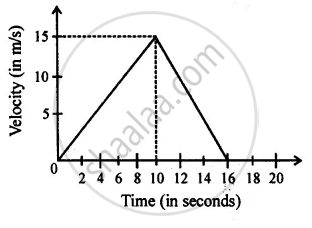
From the diagram given below, calculate distance covered by body.
Draw the speed-time graph of a body starting from some point P, gradually picking up speed, then running at a uniform speed and finally slowing down to stop at some point Q.
Draw the following graph:
Speed versus time for a stepped motion
Figure shows displacement- time graph of two objects A and B moving in a stra ight line. Which object is moving fa ster?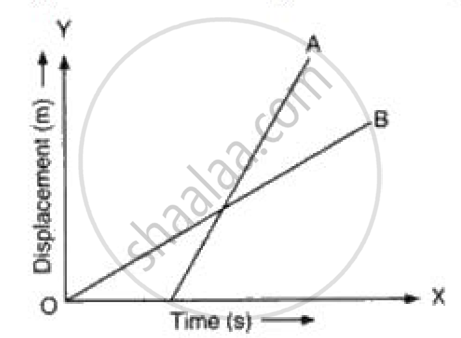
What can you say about the nature of motion of a body of its displacement-time graph is:
A straight line parallel to line axis?
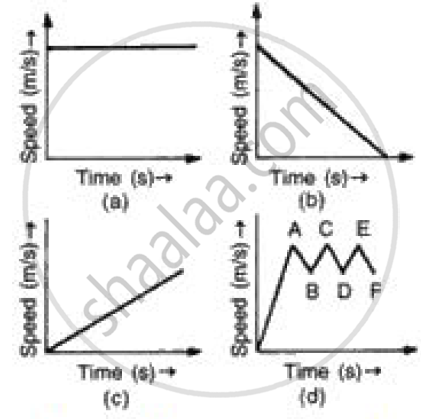
(i) In speed time graph uniform motion is given by a straight line parallel to x axis so figure (a) denotes the uniform motion.
(ii) In speed time graph motion with increasing speed is shown by straight line with positive slope so figure (c) denotes the motion with speed increasing.
(iii) In speed time graph motion with decreasing speed is shown by straight line with negative slope so figure (b) denotes the motion with speed decreasing.
(iv) In speed time graph motion with oscillating speed is shown by zigzag line so figure {d) denotes the motion with speed oscillating.
