Advertisements
Advertisements
प्रश्न
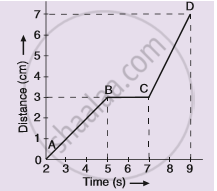
The graph given alongside shows the positions of a body at different times. Calculate the speed of the body as it moves from :
(1) A to B,
(2) B to C, and
(3) C to D.
Advertisements
उत्तर
(i) The distance covered from A to B,
= 3 – 0
= 3 cm
Time taken to cover the distance from A to B
= 5 – 2
= 3 s
Hence speed,
= `"Distance"/"Time"`
= `3/3` cm/s
= 1 cm/s
(ii) The speed of the body as it moves from B to C is zero because the distance travelled is zero.
(iii) The distance covered from C to D,
= 7 – 3
= 4 cm
Time taken to cover the distance from C to D,
= 9 – 7
= 2 s
Hence speed,
= `"Distance"/"Time"`
= `4/2` cm/s
= 2 cm/s
APPEARS IN
संबंधित प्रश्न
What can you say about the motion of an object whose distance-time graph is a straight line parallel to the time axis?
Given figure shows the distance-time graph of three objects A, B and C. Study the graph and answer the following questions:
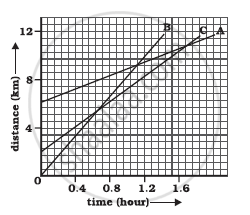
- Which of the three is travelling the fastest?
- Are all three ever at the same point on the road?
- How far has C travelled when B passes A?
- How far has B travelled by the time it passes C?
The speed-time graph for a car is shown in the following figure:
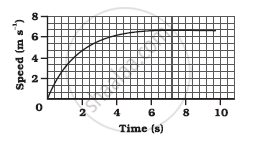
- Find how far the car travels in the first 4 seconds. Shade the area on the graph that represents the distance travelled by the car during the period.
- Which part of the graph represents uniform motion of the car?
Fill in the following blank with suitable word :
The slope of a distance-time graph indicates ………………….. of a moving body.
Fill in the following blank with suitable word :
The slope of a speed-time graph of a moving body gives its………………………..
Four cars A, B, C and D are moving on a levelled, straight road. Their distance-time graphs are shown in the given figure. Which of the following is the correct statement regarding the motion of these cars?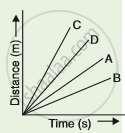
A student draws a distance-time graph for a moving scooter and finds that a section of the graph is horizontal line parallel to the time axis. Which of the following conclusion is correct about this section of the graph?
Figure (a) shows the displacement-time graph for the motion of a body. Use it to calculate the velocity of the body at t = 1 s, 2 s and 3 s, and then draw the velocity-time graph in Figure (b) for it.
 |
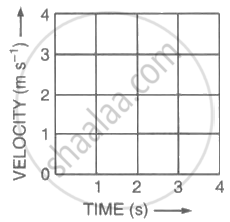 |
| (a) | (b) |
What are the uses of the graphical study of motion?
What do you infer if
- Distance – time graph is a straight line.
- The velocity-time graph is curved.
- Displacement time is zigzag.
