Advertisements
Advertisements
प्रश्न
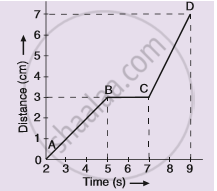
The graph given alongside shows the positions of a body at different times. Calculate the speed of the body as it moves from :
(1) A to B,
(2) B to C, and
(3) C to D.
Advertisements
उत्तर
(i) The distance covered from A to B,
= 3 – 0
= 3 cm
Time taken to cover the distance from A to B
= 5 – 2
= 3 s
Hence speed,
= `"Distance"/"Time"`
= `3/3` cm/s
= 1 cm/s
(ii) The speed of the body as it moves from B to C is zero because the distance travelled is zero.
(iii) The distance covered from C to D,
= 7 – 3
= 4 cm
Time taken to cover the distance from C to D,
= 9 – 7
= 2 s
Hence speed,
= `"Distance"/"Time"`
= `4/2` cm/s
= 2 cm/s
APPEARS IN
संबंधित प्रश्न
Show the shape of the distance-time graph for the motion in the following case:
A car parked on a side road.
What does the slope of a distance-time graph indicate ?
Fill in the following blank with suitable word :
The slope of a distance-time graph indicates ………………….. of a moving body.
Fill in the following blank with suitable word :
The slope of a speed-time graph of a moving body gives its………………………..
Name the two quantities, the slope of whose graph give speed .
A cyclist is travelling at 15 m s-1. She applies brakes so that she does not collide with a wall 18 m away. What deceleration must she have ?
A student draws a distance-time graph for a moving scooter and finds that a section of the graph is horizontal line parallel to the time axis. Which of the following conclusion is correct about this section of the graph?
Write down the type of motion of a body in each of the following distance time-graph.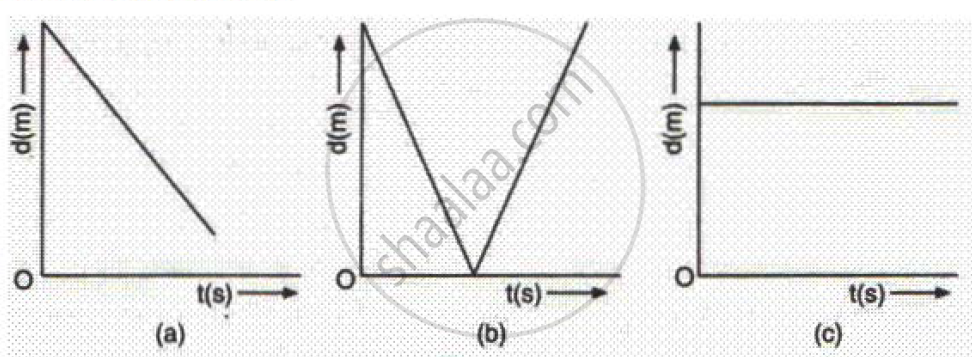
Distance between Bholu’s and Golu’s house is 9 km. Bholu has to attend Golu’s birthday party at 7 o’clock. He started from his home at 6 o’clock on his bicycle and covered a distance of 6 km in 40 minutes. At that point, he met Chintu and he spoke to him for 5 minutes and reached Golu’s birthday party at 7 o’clock. With what speed did he cover the second part of the journey? Calculate his average speed for the entire journey.
Assertion: The position-time graph of a uniform motion in one dimension of a body can have a negative slope
Reason: When the speed of the body decreases with time then, the position-time graph of the moving body has a negative slope.
