Advertisements
Advertisements
प्रश्न
What can you say about the motion of a body if:
its velocity-time graph is a straight line ?
Advertisements
उत्तर
The body has a uniform acceleration if its velocity-time graph is a straight line. If the straight line is parallel to the time axis then the magnitude of uniform acceleration is zero.
APPEARS IN
संबंधित प्रश्न
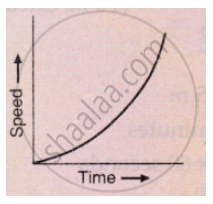
What conclusion can you draw about the acceleration of a body from the speed-time graph shown below .
Draw a velocity-time graph to show the following motion :
A car accelerates uniformly from rest for 5 s ; then it travels at a steady’ velocity for 5 s.
The speed-time graph of an ascending passenger lift is given alongside. What is the acceleration of the lift:
(1) during the first two seconds ?
(2) between second and tenth second ?
(3) during the last two seconds ?
Study the speed-time graph of a car given alongside and answer the following questions:
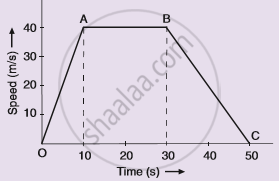
(i) What type of motion is represented by OA ?
(ii) What type of motion is represented by AB ?
(iii) What type of motion is represented by BC ?
(iv) What is the acceleration of car from O to A ?
(v)What is the acceleration of car from A to B ?
(vi) What is the retardation of car from B to C ?
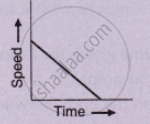
What type of motion is represented by the following graph ?
What does the slope of velocity-time graph represent?
Draw velocity – time graph for the following situation:
When a body, is moving with uniform velocity.
Represent the location of an object described as at 15 m, 45o west of north, on a graph paper.
Represent the position of a body described as at 15 m, 30o north of west, on a graph paper.
If the velocity-time graph has the shape AMB, what would be the shape of the corresponding acceleration-time graph?

