हिंदी

What Conclusion Can You Draw About the Acceleration of a Body from the Speed-time Graph Shown Below

Advertisements
Advertisements

प्रश्न

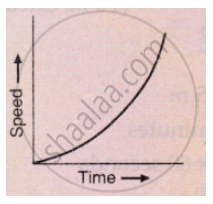
What conclusion can you draw about the acceleration of a body from the speed-time graph shown below .
एक पंक्ति में उत्तर
Advertisements

उत्तर

It represents non-uniform acceleration. In this kind of motion, speed doesn’t vary linearly with time.

shaalaa.com
  क्या इस प्रश्न या उत्तर में कोई त्रुटि है?
अध्याय 1: Motion - Very Short Answers 2 [पृष्ठ ४०]

APPEARS IN

लखमीर सिंग Physics (Science) [English] Class 9 ICSE
अध्याय 1 Motion
Very Short Answers 2 | Q 13 | पृष्ठ ४०

वीडियो ट्यूटोरियलVIEW ALL [1]

संबंधित प्रश्न

The velocity-time graph for part of a train journey is a horizontal straight line. What does this tell you about the trains velocity.


A body is moving uniformly in a straight line with a velocity of 5 m/s. Find graphically the distance covered by it in 5 seconds.


The speed-time graph of an ascending passenger lift is given alongside. What is the acceleration of the lift:
(1) during the first two seconds ?
(2) between second and tenth second ?
(3) during the last two seconds ?


Study the speed-time graph of a car given alongside and answer the following questions:

(i) What type of motion is represented by OA ?
(ii) What type of motion is represented by AB ?
(iii) What type of motion is represented by BC ?
(iv) What is the acceleration of car from O to A ?
(v)What is the acceleration of car from A to B ?
(vi) What is the retardation of car from B to C ?


Define speed. What is its S.I. unit?


Diagram shows a velocity – time graph for a car starting from rest. The graph has three sections AB, BC and CD.

From a study of this graph, state how the distance travelled in any section is determined.


A train starting from rest picks up a speed of 20 ms−1 in 200 s. It continues to move at the same rate for the next 500 s and is then brought to rest in another 100 s.

  1. Plot a speed-time graph.
  2. From graph calculate
    (a) uniform rate of acceleration
    (b) uniform rate of retardation
    (c) total distance covered before stopping
    (d) average speed.

From the velocity – time graph given below, calculate Average velocity in region CED.


Diagram is given below shows velocity – time graph of car P and Q, starting from the same place and in the same direction. Calculate at what time intervals both cars have the same velocity?


Name the physical quantity which is equal to the area under speed-time graph.


Share
Notifications

Englishहिंदीमराठी


      Forgot password?
Use app×