Advertisements
Advertisements
प्रश्न
A car of mass 1000 kg is moving with a velocity of 10 m s−1. If the velocity-time graph for this car is a horizontal line parallel to the time axis, then the velocity of car at the end of 25 s will be :
विकल्प
25 m s−1
40 m s−1
10 m s−1
250 m s−1
Advertisements
उत्तर
It is given that the velocity time curve is parallel to x axis hence velocity is constant with time and acceleration is 0. So, the answer is
(c) 10 m s−1
APPEARS IN
संबंधित प्रश्न
What is the quantity which is measured by the area occupied below the velocity-time graph?
Name the two quantities, the slope of whose graph give acceleration.
Represent the position of a body described as at 15 m, 30o north of west, on a graph paper.
Interpret the following graph: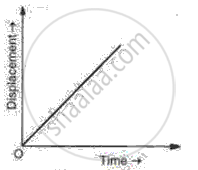
Figure shows displacement- time graph of two objects A and B moving in a stra ight line. Which object is moving fa ster?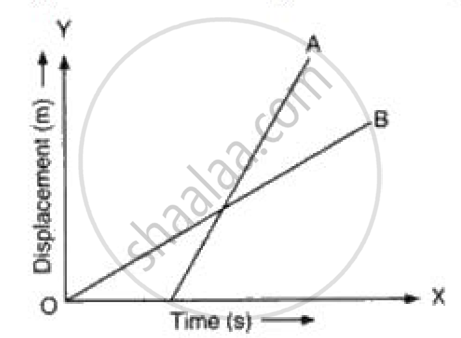
What can you say about the nature of motion of a body of its displacement-time graph is:
A straight line parallel to line axis?
Derive the equation
S = ut+ `1/2` at2
Using a speed- time graph
Draw the distance-time graphs of the bodies P and Q starting from rest, moving with uniform speeds with P moving faster than Q.
From the v-t graph, ______ can be calculated.
An object is moving in a positive direction with positive acceleration. The velocity-time graph with constant acceleration which represents the above situation is:
