Advertisements
Advertisements
प्रश्न
Represent the position of a body described as at 15 m, 30o north of west, on a graph paper.
Advertisements
उत्तर

APPEARS IN
संबंधित प्रश्न
A body with an initial velocity x moves with a uniform acceleration y. Plot its velocity-time graph.
Diagram shows a velocity – time graph for a car starting from rest. The graph has three sections AB, BC, and CD.
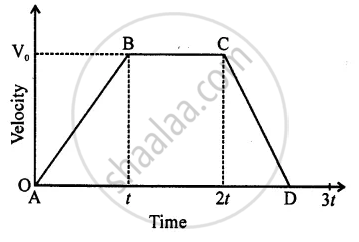
In which section, car has a zero acceleration?
A train starting from rest picks up a speed of 20 ms−1 in 200 s. It continues to move at the same rate for the next 500 s and is then brought to rest in another 100 s.
- Plot a speed-time graph.
- From graph calculate
(a) uniform rate of acceleration
(b) uniform rate of retardation
(c) total distance covered before stopping
(d) average speed.
How will you use a speed-time graph to find whether the acceleration of the body is uniform or not?
Draw the speed-time graph of a body when its initial speed is not zero and the speed increases uniformly with time.
Draw the following graph:
Distance versus time for a body at rest.
Draw velocity-time graph to show:
Zero acceleration
Write a sentence to explain the shape of graph.
Which of the following can determine the acceleration of a moving object.
Slope of the velocity-time graph gives ______.
The given graph shows the variation of velocity (v) with position (x) for a particle moving along a straight line
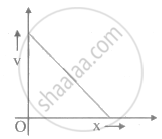
Which of the following graph shows the variation of acceleration (a) with position (x)?
