Advertisements
Advertisements
प्रश्न
A ball is thrown up vertically and returns back to thrower in 6 s. Assuming there is no air friction, plot a graph between velocity and time. From the graph calculate
- deceleration
- acceleration
- total distance covered by ball
- average velocity.
Advertisements
उत्तर
A ball is thrown up vertically and returns to thrower in 6s. It means the ball takes 3s to reach the highest point and 3s to reach the earth from the highest point.

For the upward motion of a ball
u = ?
v = 0
a = −g = −10 ms−2
t = 3s
v = u + at
0 = u − 10(3)
u = 30 m/s
⇒ In the graph, OA = CD = 30 m/s
(i) When the ball moves upwards, then it decelerates.
From graph, deceleration = − slope of graph AB
= `-"OA"/"OB"=-30/3` = −10 ms−2
(ii) When ball falls downwards then acceleration = Slope of v.t. graph BC
= `"CD"/"BD"=30/3` = 10 ms−2
(iii) Total distance covered = area under v.t. graph
= ar(ΔOAB) + ar(ΔBCD)
= `1/2xx"OB"xx"OA" + 1/2xx"BD"xx"CD"`
= `1/2xx30xx3+1/2xx30xx3`
= 45 + 45
= 90 m
(iv) Ball returns back to thrower in 6s.
⇒ Displacement after 6s = 0
Average velocity = `"Time distance covered"/"Total time taken"=0/6` = 0
Average speed = `"Total distance covered"/"Total time taken"=90/6` = 15 ms−1
APPEARS IN
संबंधित प्रश्न
What is the quantity which is measured by the area occupied below the velocity-time graph?
Show by means of graphical method that: v = u + at, where the symbols have their usual meanings.
A body is moving uniformly in a straight line with a velocity of 5 m/s. Find graphically the distance covered by it in 5 seconds.
Diagram shows a velocity – time graph for a car starting from rest. The graph has three sections AB, BC and CD.
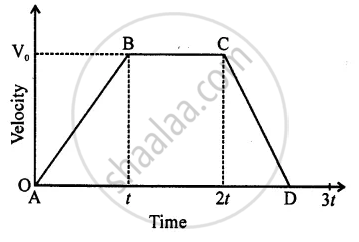
Compare the distance travelled in section BC with the distance travelled in section AB.
The area of the right triangle under a speed-time graph is 500 m, in a time interval of 20 s. What is the speed of the body? Is the motion uniform or non-uniform?
What can you conclude if the speed-time graph of a body is a straight line sloping upwards and not passing through the origin?
Its time-displacement graph is a straight line.
What does the slope of velocity-time graph represent?
Derive the equation
S = ut+ `1/2` at2
Using a speed- time graph
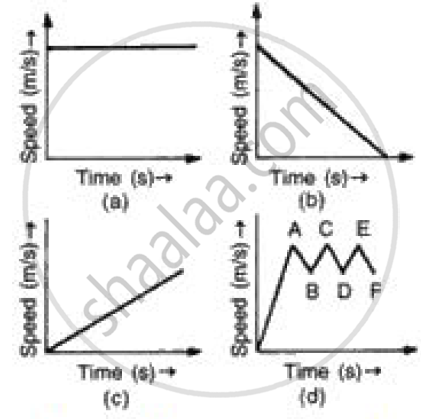
(i) In speed time graph uniform motion is given by a straight line parallel to x axis so figure (a) denotes the uniform motion.
(ii) In speed time graph motion with increasing speed is shown by straight line with positive slope so figure (c) denotes the motion with speed increasing.
(iii) In speed time graph motion with decreasing speed is shown by straight line with negative slope so figure (b) denotes the motion with speed decreasing.
(iv) In speed time graph motion with oscillating speed is shown by zigzag line so figure {d) denotes the motion with speed oscillating.
